


Hi writers,
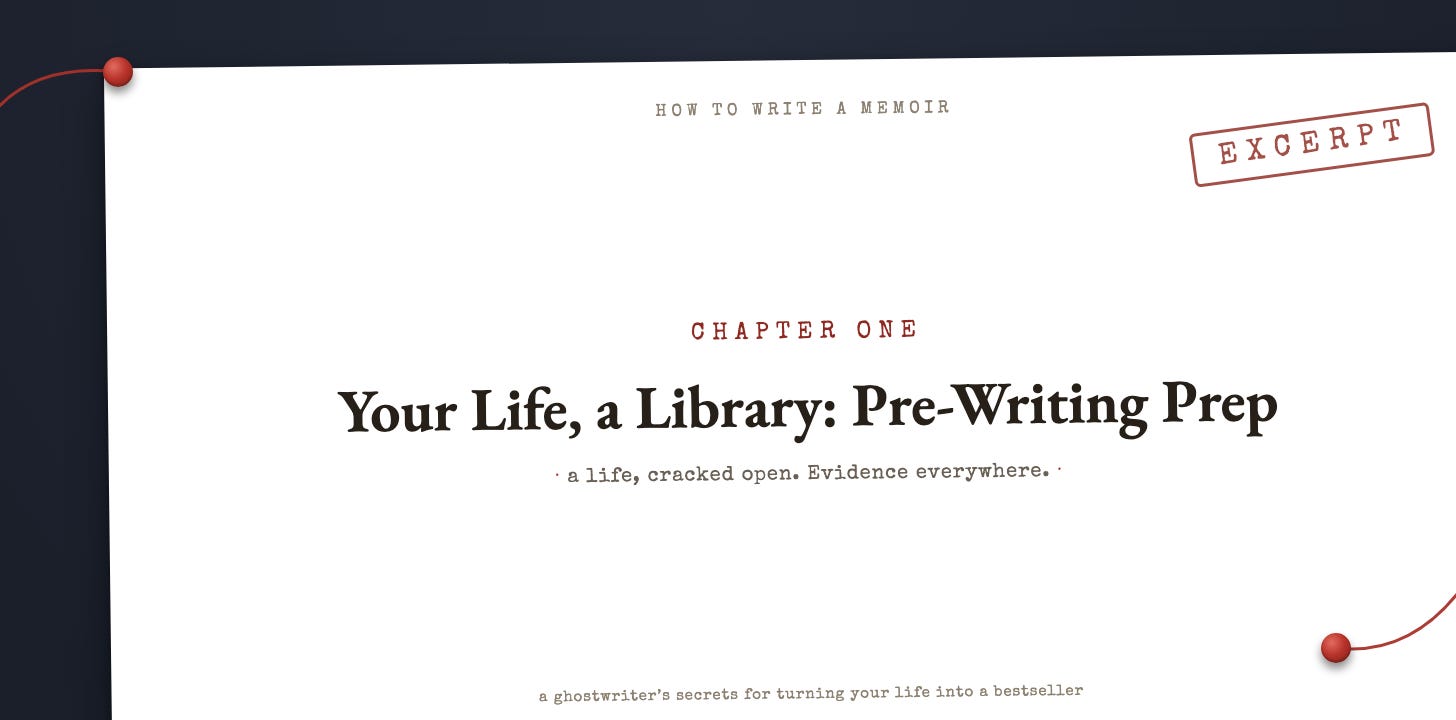
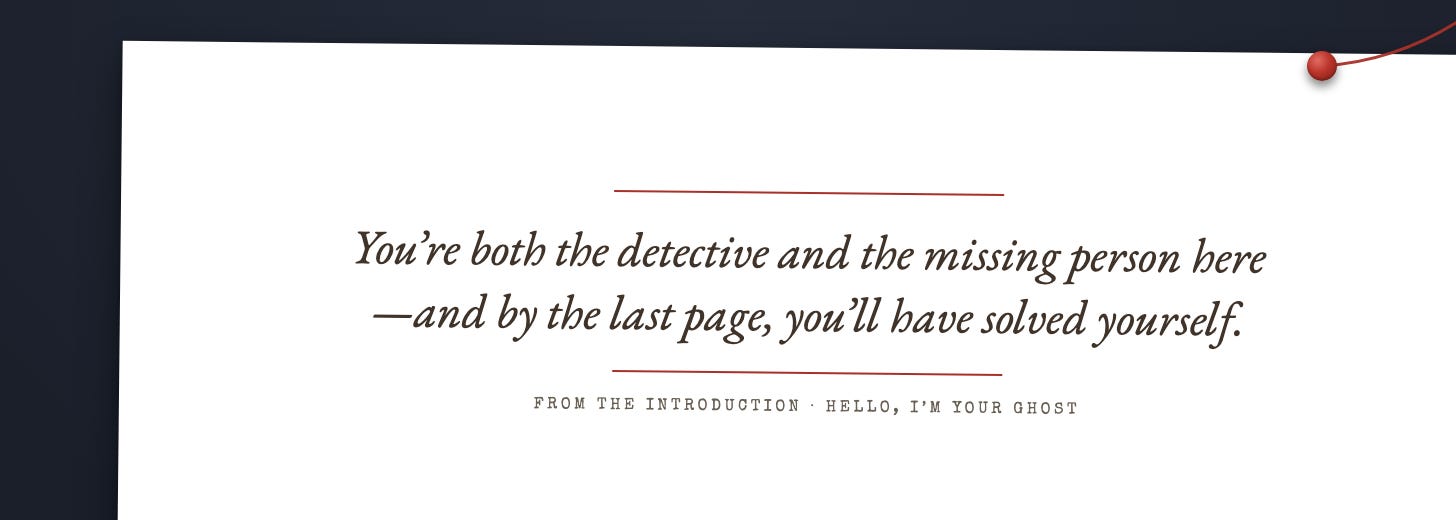
Last Sunday I told you about How to Write a Memoir, the book I never published that comes free with any preorder of my novel, Let Me Be Your Ghost. Today I’m giving you most of Chapter One, the part where I explain why you should treat your own life the way a detective treats a case.
First, the dates. You have 10 days. Preorder Let Me Be Your Ghost in any format, from any retailer, by midnight Pacific on Tuesday, November 17. Upload your receipt on my site, and the memoir book lands in your inbox in PDF and EPUB, usually within minutes. Buy one book, get two.

🕵️ A Sneek Peak at Chapter One of How to Write A Memoir
Get a look inside my unreleased book How to Write a Memoir below:
I started writing this book in a coffeeshop called Dope Coffee in Athens, Greece. I had grown fond of drinking caffeine in the cobblestone streets of Europe over the past few years, and was working remotely in Athens for the month—and not in a rush to leave.
Sun streamed in through the open windows, glinting off the mosaic tiles on the floor of the coffeeshop. Laptop nomads worked at the wooden bar or individual tables in the garden outside. My unsweetened matcha latte—and they always come unsweetened in Europe—dripped condensation next to my MacBook Air.
My first question to myself as I opened a new document on my laptop was:
Who is this book for?
It’s the most important question authors need to ask—and one of the most overlooked. When you visualize your audience, what do they want to experience in absorbing your story? Are they wanting to be inspired by your courage? Your vulnerability? Are they needing a good laugh, a hard cry? Are they lost and looking for a role model to show them the way in a hybrid self-help book/memoir? Are they wanting to grow their business like you grew yours, and want to read a business book/memoir where they can follow your journey and learn what they need with theirs?
I’ll break it down further for you.
A Dame Walks Into Your Office
Imagine you’re an old-time-y hardboiled detective. Private Eye is written across the stained glass of your office door. Your wrinkled suit and thousand-yard stare show that you’ve seen things—things most people can only dream of.
Your afternoon peace is broken when your door slams! open—and a dame walks in.
She pulls off her white gloves, her mascara stained and her messy hair hidden under a hat, and tearfully looks across at you.
“Won’t you help me, detective?”
This is your audience, dear writer. They’re in your office with a “problem” they want solved. They want inspiration. They want escapism. They want their cheating ex-husband caught and punished for his sins (your book might not be able to help with this last one).
Whenever you feel lost, imagine yourself sitting across from your reader, who is begging to hear your life story—and understand that you’re writing to them as if they’re there listening. This will help you keep the reader experience in your mind as you start to understand your why.
Your Detective Origin Story
Begin by asking yourself the simplest question you can to kickstart your investigation:
Why am I writing this book?
This is a question I ask all of my clients before I start work with them. Everyone’s goals are different when it comes to writing a book. For some, they just want a story they can pass on to their families. For others, they want a commercial smash hit that will benefit their career or business.
It’s important to understand your “why” when you’re starting your book, because that will dictate the approach you’ll take. If you’re not clear on your vision for your book, it’s like going on a hike without knowing where you’re hiking to: you’re likely to get lost and confused on a spiderweb of trails.
The clients I’ve worked with who had the best outcome of their book had a clear vision but an open mind along the way.
You’ve got to know what you want—but part of the fun of writing a book is the exploration that unfolds across multiple drafts. If you stumble upon secluded hot springs along your hike, are you going to just walk by because a dip in the water is not on your itinerary? Part of the joy of writing is the indulgence of your curiosity—and that indulgence of play will improve the quality of your work.

Preparing to Write: Assembling the Case Files
One of my favorite parts of the memoir writing process is actually the beginning, where we dive into the pool of someone’s vast memories and start to swim around, looking for meaning.
Getting as close to objectivity as possible should be the goal of your memoir writing process. It’s the name of the game… and genre (nonfiction).
You’ll need to pick up your magnifying glass and binoculars and start searching through your life far and wide to begin laying the groundwork for a nuanced, honest memoir.
As you reflect on the major events of your life, lean on all the resources around you. Include your family and friends in this process. Ask them about their perspective of shared memories. Obsess over old family albums, sift through archived text messages, dig through diaries, and cook old recipes.
Doing all of this is going to help you write your story with detail, honesty, and objectivity. You do not want to write from your memory alone. We’re not nearly as good at remembering things as we’d like to think.
When Your Memory Lies to You
In a 2009 study, psychologists discovered that certain factors, such as how we felt during a particular event, have a direct impact on the accuracy of our recollections of that event.
Participants in the study were surveyed on their emotional recall of life events, which they labeled either positive or negative. It was found that the emotional intensity participants remembered feeling during negative events was significantly more likely to fade over time (51% of negative events) versus that emotional intensity remaining fixed (38% of negative events).
In simpler terms, our brains edit how we remember feeling during major life events as time moves on.
It’s how many people process trauma and remain hopeful about their future, and why the adage “time heals all wounds” actually takes hold.
3 Ways to Uncover the Truth About Your Life for Your Memoir
Discovering the truth about your life requires some bravery and perseverance, so don’t give up before you get to your truth.
Here are three of my top suggestions for tracking down the truth:
Seek out primary sources. Primary source documents like old social media posts, diary entries, VHS tapes, or other recordings can help you capture a memory in amber. If you were a researcher writing a paper about your life, these would be your citations. Trust them over the highlight reel in your head.
Journal on old memories. Write about sights, smells, and events in your past. Pick something specific, like the day you went apple picking with your mother in endless orchards.
Compare notes with friends and family. For shared memories, it’s helpful to see what others remember, too. By comparing notes, you’ll be able to get closer to a more unbiased reality. Ask for what specific details others remember, too: these forgotten pieces can help you paint an even more fleshed-out picture of past events.
When in doubt, follow your curiosity and ask as many questions as you can.
Phone a Friend (and Family Member)
Friends and family offer something you can’t generate on your own in the investigation of your major life events: an outside perspective. Your memories are from your point of view after all and are never the whole picture.
When I’m working with clients, I sometimes interview other people in their life to reveal hidden details or forgotten memories that alter the story. In the puzzle of the phenomenon of memory, it’s interesting to compare notes on who remembers what—even if what they remember is “wrong” compared to your recollection. Ask yourself: why does this person remember this event this way, even if I remember it differently? Our feelings about people and events color our memory of them, after all.
Besides the people in your immediate circle, it’s also helpful to interview key people from your past who you aren’t as close to, as they’ll be more objective. Your best friend in middle school probably has some useful memories of you. Don’t be afraid to include exes, family friends, teachers, and even past crushes (if you dare) in your process. Consider this an excuse to re-connect, bond, and step out of your own head.
Meet in-person when you can. Buy your friends and family members lunch or coffee as a thank-you, and see what comes up in conversation. Even shared memories about other people around you can help add texture to your life story: your life is about more than just you, after all. It’s about your environment and the people you changed or who changed you.
No matter who you’re interviewing though, have a few memories and questions ready to discuss before you meet up. This will help guide the conversation if it turns stale. Also, stick with non-leading questions like, “what was your perception of me?” or “what do you remember about high school?” You’ll get answers that are infinitely more interesting than a simple yes/no/maybe so.
My favorite interviewing trick, and the one I lean on with every memoir client, is what I call the kitchen-table question. Ask someone a huge, abstract question about their life and you’ll get a shrug. Ask about the kitchen table instead, and suddenly it’s 1974 in the room. The specific physical detail is the clue, and the bigger memory is the case it cracks open. So skip “what was your childhood like?” and try “what did your mother keep on the kitchen counter?” You’ll be amazed at what turns up.
Still need interview inspiration? Watch clips of your favorite talk show hosts or listen to your favorite interview podcasts. Take notes on how they converse with their guests. Write down questions they ask that jive with you. And if you’re still nervous, remember: you’re doing it for the story.
📂 One more page, from the ghostwriting chapter
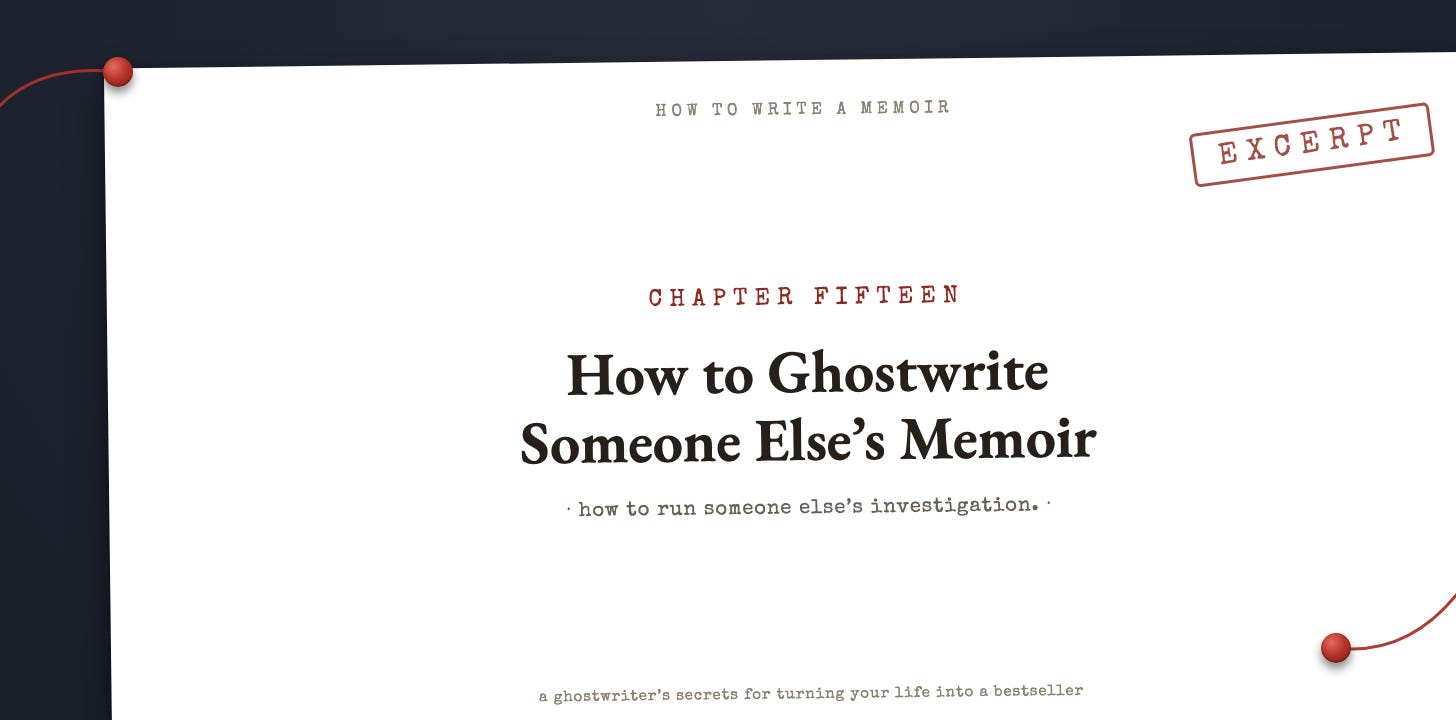
Chapter Fifteen is the ghostwriting chapter, where I explain how I disappear into someone else’s life and come back holding a book. The questions I ask a founder about their first office are the questions you just read about asking your mother, so here is the start of the interview section, and then I’ll let you go.
The Interview Room
Interviewing is the craft inside the craft, and almost nobody teaches it, so here is my actual toolkit as a professional memoir ghostwriter:
Record everything, with permission, and get transcripts made. You think you’ll remember. You will not, and flipping through transcripts at outline time is how themes announce themselves.
Ask kitchen-table questions, not big abstractions. You learned this in chapter one. “What was your childhood like?” produces a shrug. “Walk me through your front door in 1985” produces a chapter.
Let silence work. When a client finishes an answer, wait three extra seconds before your next question. The sentence that arrives in that silence is frequently the reason the book exists. Beginners rush to fill the pause. Professionals let it get a little uncomfortable.
Chase the senses. When a client mentions a moment that matters, slow the tape: what did the room smell like, who else was there, what were you wearing, what did you eat afterward? You’re not being precious. You’re collecting the raw material scenes are made of.
That section has three more rules, and then the chapter hands you the 20 questions I actually ask clients, written to produce scenes instead of summaries. The whole book is 16 chapters, 11 Case Files from real projects with the names changed, and 15 sets of writing prompts, for your own memoir or someone else’s. I started it in 2021, rewrote the whole draft in Athens coffee shops on way too many Freddo espressos, and it has never been for sale.
Preordering the novel is the only way to read it.
📦 Every gift, one more time
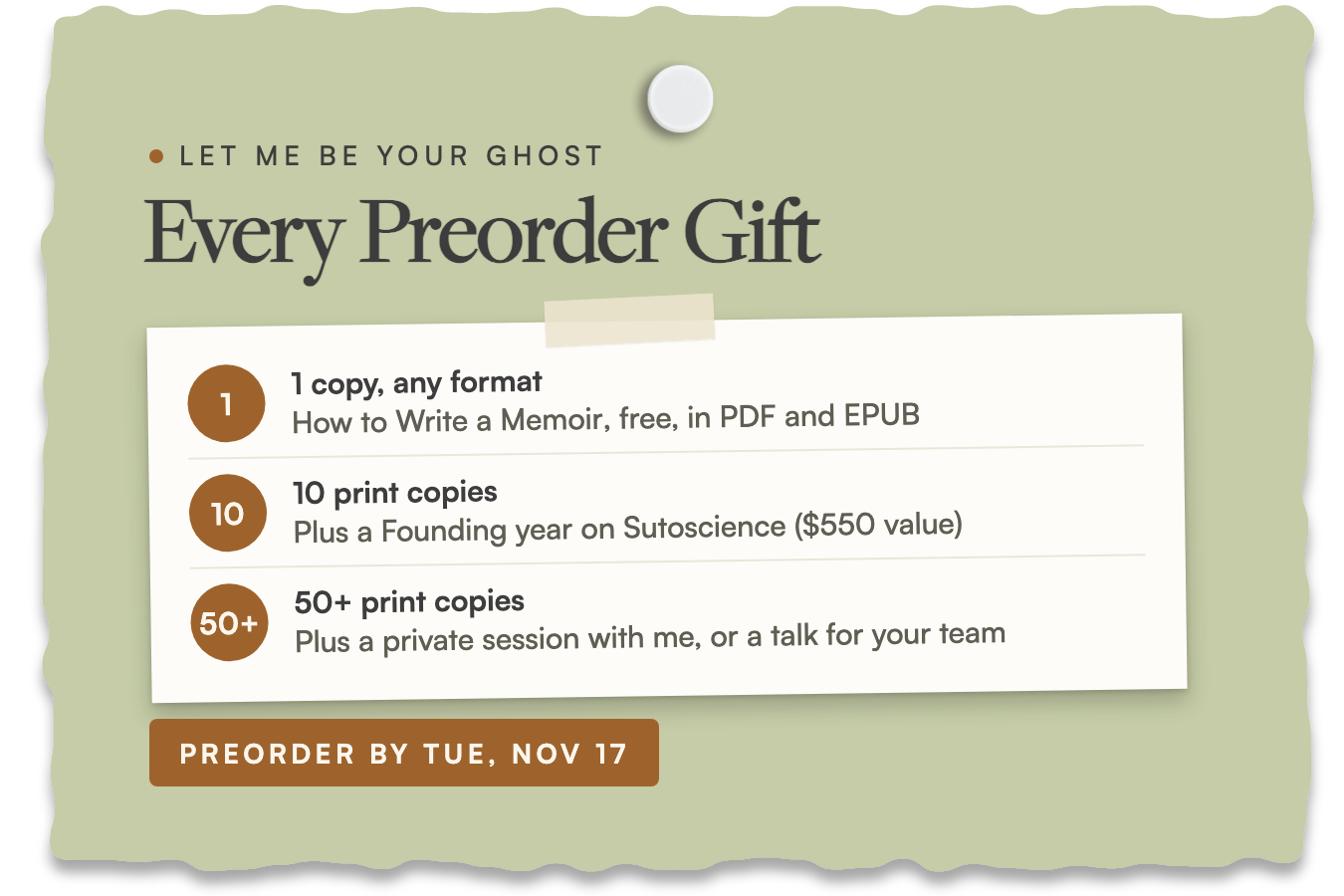
One copy, any format, gets you How to Write a Memoir in PDF and EPUB. Ten print copies (about $220 in paperbacks) also gets you a year of Founding membership to 💡 Sutoscience, my personal Substack, which normally costs $550 and comes with our monthly Substack Lab calls and the 6 Week Substack Sprint. Fifty or more print copies adds a private session with me, or a talk for your team, institution or organization.
To claim, preorder from any retailer (Amazon, Bookshop.org, Barnes & Noble, or The Ripped Bodice if you shop indie), then upload your receipt on the claim page. The free book comes with preorders placed by midnight Pacific on Tuesday, November 17.
Already preordered and never claimed? Uploads stay open through November 30, so go do it now.
Go ask someone about their kitchen table this week. Then wait the three seconds.
-Amy