


Hi writers,
One of my first memoir clients invited me to her family reunion at a winery in Southern California. She had taken a DNA test, found out her father was not her biological father, and brought her newly found family to meet everyone. There were tears. There was some fighting. And in the middle of it all she turned to her relatives and said, “Oh, by the way, this is Amy, my ghostwriter. Go talk to her.”
I told that story to Brendan O’Meara on The Creative Nonfiction Podcast, where he has been interviewing nonfiction writers since 2013. He’d talked with co-writers before but never a true ghost, so we spent most of an hour on the craft of memoir ghostwriting. Episode 550 is out now.
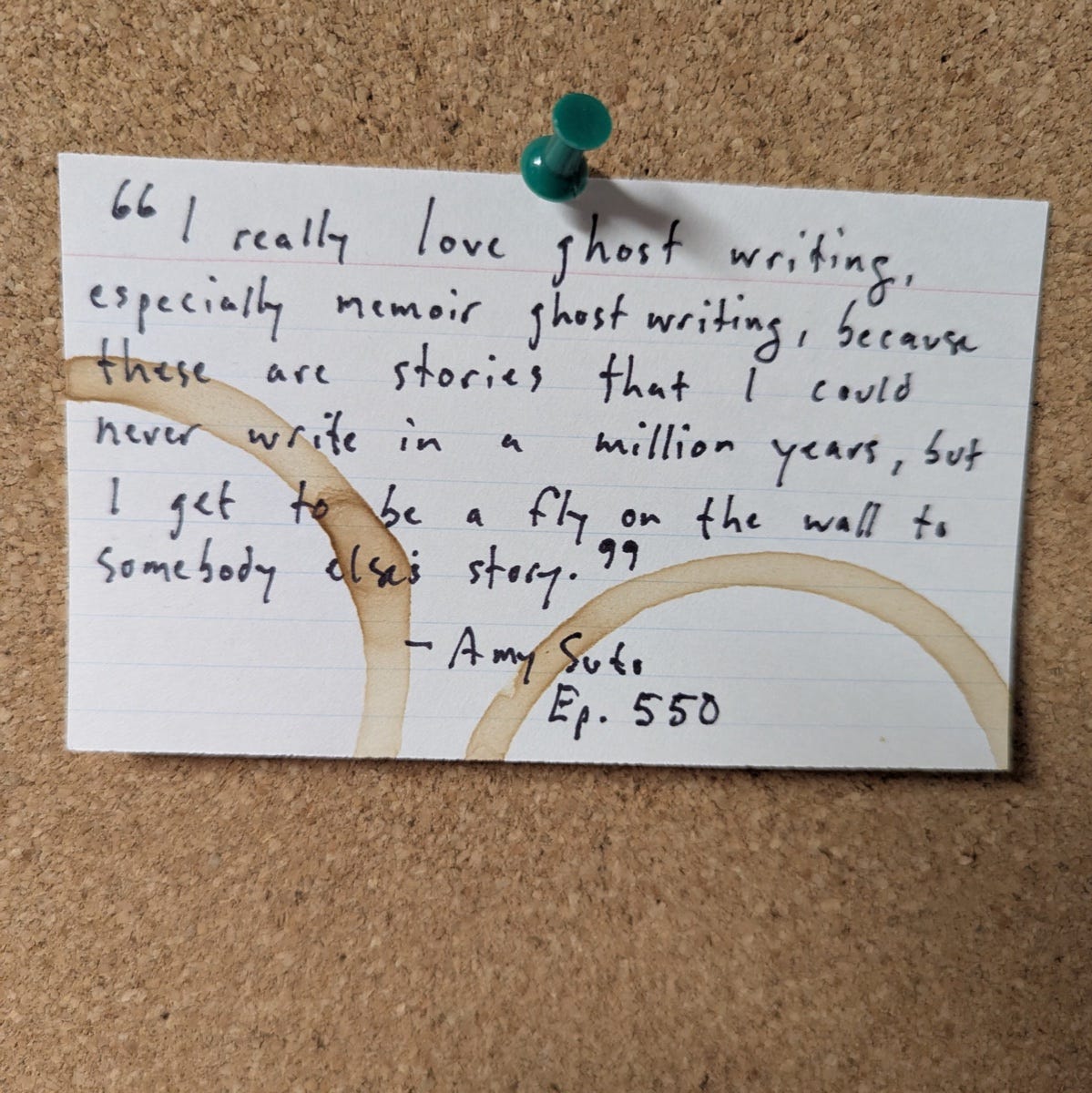
It’s also on Spotify, and Brendan’s show notes are on his site.
✍️ How I learn a client’s voice
I record hours of conversation with my clients, then I go back and listen to the tapes to hear how they would actually say something. Their voice on the page should be a slightly elevated version of the way they talk, with their phrases and quirks still in it. You can always tell when a celebrity memoir had a heavy-handed ghost. Three chapters in, you think, wow, I had no idea this person was so articulate.
I also read pages out loud, a habit from my old writers’ groups in LA. And when I can, I ask a client’s partner or best friend to read along. More than once someone has told me a joke sounds wrong, that their person would tell it a different way.
✍️ Memory works like a spotlight
At a magic lecture in San Francisco, the magician explained that we don’t take in the world like a video camera. We see it like a spotlight, and we miss everything outside the beam. That’s why sleight of hand works.
It’s also why memoir is hard. When I interview a client’s family, everyone’s spotlight is pointed somewhere different, and sometimes a relative remembers a painful moment completely differently than my client does. Then I go back to my client, very gently, and ask how they want to handle it on the page.
On one book the family material was so sensitive that we turned the memoir into a novel inspired by a true story. Even swapping in placeholder names for a first draft can give a client enough distance to open up.
✍️ The essay that got me a book
Before I had a single full book to show anyone, I pitched myself as a ghostwriter with my short stories and my Hollywood experience. Then I wrote a deeply personal essay for the LA Times. A client read it and told me that if I had the courage to publish something like that, I could handle their story.
So if you want to write other people’s memoirs, publish something personal of your own first. Clients want proof you can handle the hard parts.
✍️ Also in the episode
Why I have to like a client before I’ll write their book
The early client who sat me down and said, “Amy, you are undercharging,” and why charging more keeps you from burning out
The NaNoWriMo trick I still use: when you’re stuck, have your characters sing song lyrics until you remember what they were going to say
What I learned when my TV show got canceled in the middle of the writers’ room, and Mark Duplass’s talk “The Cavalry Is Not Coming”
My recommendation, The Prisoner, the 1960s spy show that inspired Lost
Brendan opened the episode with a line of mine: every time somebody passes away, it’s like a library burning to the ground. It’s the reason I love this work.
If you want to write your own memoir, or a parent’s or grandparent’s, I put everything I’ve learned as a ghostwriter into a guide called How to Write a Memoir. I’ve never published it. You get it free when you preorder my novel Let Me Be Your Ghost, a romantic thriller about a memoir ghostwriter, out November 18.
Big thanks to Brendan for having me. If you pitch magazines, his Substack Welcome to Pitch Club is for writers who want to get better at selling their stories.
-Amy