


📚 Editor’s Note: When Reading Becomes Resistance
Through her bestselling Substack Heavy Meta, Tarra has created a space where reading isn’t just a pastime — it’s a practice, a discipline, and a form of resistance. Grounded in her work as an English teacher and Writing Center Director at a girls’ school, her Girls’ School Book Club brings feminist theory, banned books, conceptual metaphor, and lived experience into conversation with the world as it is now.
What I love about Tarra’s work is how she’s not afraid to dig deep. Nothing in her work is rushed or shallow. Each month’s reading is part of a larger ecosystem — essays, resources, discussions — designed to help readers think more deeply and read more deliberately. There’s a care to the way she builds community, protects it, and asks people to value both the labor and the learning involved.
This interview is a reminder that making writing your job doesn’t always look loud or linear. Sometimes it looks like teaching, reading closely, showing up consistently, and trusting that depth will find its audience — because it always does.
– Amy Suto
Editor & Curator of GuestStack
✍️ From the Desk of Tarra Stevenson
Where’s your desk these days — and what does it look like?
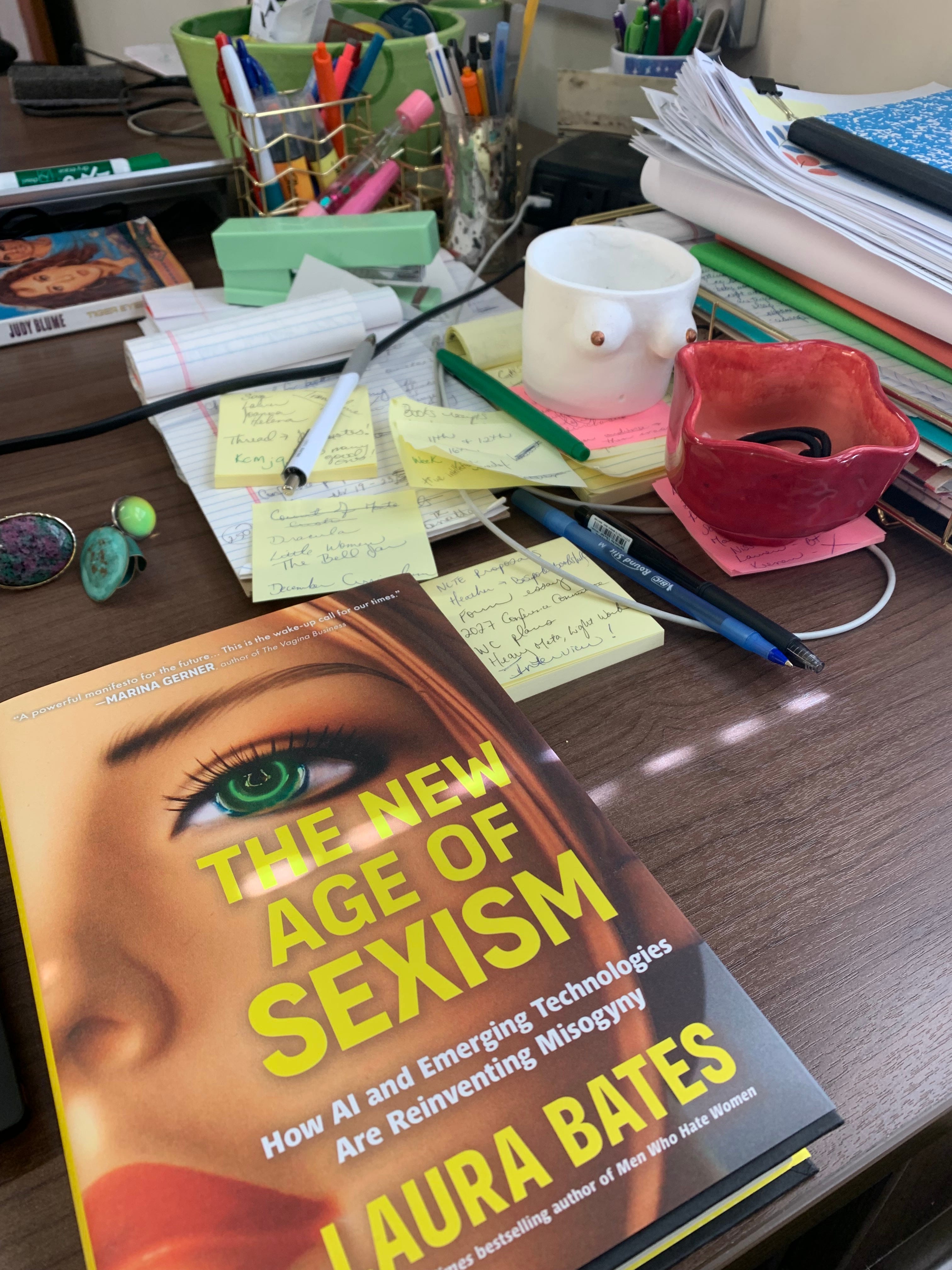
I live and work in the Stars Hollow of the San Gabriel Mountains, in a little town outside of Pasadena, CA. I have two work spaces: one, my desk at work, where I’m a full time English teacher and Writing Center Director at an all girls’ school, and my second, my desk/vanity at home, where the vanity light serves well for making TikTok videos on paired reading and book club topics. My chair at home is a pink, overstuffed chair leftover from my Covid work-at-home days. Both desks are full of bookstacks (both vertical and horizontal), pens, post-it notes, student-made ceramic vessels that are vaguely anatomical, coffee cups, and big rings – I love a big ring but have to take them off when I write, so they’re inevitably forgotten and accumulate. I can’t stand a messy house but a messy desk doesn’t bother me.
On your Substack Heavy Meta, you run the Girls’ School Book Club. Would you tell us about the book club and what inspired you to start it?
Like all intellectual endeavors, it started on TikTok (haha). I joke but social media in general, as harmful as it can be, allows for such democratization of ideas that I can’t fault it entirely, and it was where I turned after the 2025 presidential inauguration. I joined and started creating on January 23, due to a confluence of events: the Eaton Fire which directly impacted my community, the aforementioned inauguration, and a girls’ education research project I was completing for a fellowship. I already had a Substack account that I posted on about twice a year, but I certainly wasn’t writing or reading on it regularly.
In January my students were scheduled to read Fahrenheit 451, but after the fire, in my position as Department Chair, I chose to postpone the text. I wanted to divorce the possibility of retraumatizing students and attaching a grade to it, but I also recognized that some students were still up for it, and in the face of the inauguration, would want to discuss the concept of banned books and authoritarianism. I asked my Writing Center students if they wanted to start/host a banned books club–of course they did–and so we got that up and going. And that planted the seed.
Of course, I wanted something similar for myself. I started discussing banned books specifically through the lens of girls’ schools and feminism on my new TikTok account, and around the summer, after layering my content the way I do my classes, with conceptual metaphor theory, feminist and post-colonial theory, non-fiction, other literary fiction, etc., I went for it, and thus on July 1, 2025, Girls’ School Book Club was born.
Girls’ schools are inherently political, inherently about resistance. They existed outside the realm of the acceptable for a long time, calling themselves finishing schools because the idea of real, true, education was reserved for boys. For men. Even the term, finishing! Once girls learn etiquette, we’re done (for). The confluence of my work in a girls’ school, the state of the country, and my own convictions, made me realize the radical nature of such a book club, and so “reading is resistance” became the mission and my compass rose.
What does “making writing your job” look like in your world right now when it comes to the work you put out on your Substack, any projects you’re doing as a writer yourself, and the coordination of your book club?
When it comes to the work I put out on my Substack, I want to create a cohesive experience for my readers. Every month we read two specific books/texts, and everything I write about that month is thematically connected to those texts. My creation of resources is often connected to a need I find in my book club community.
I have never considered myself a business person, so I went into this whole process completely blind, but over the course of the past 6 months since the book club has been up and running, I’m finally learning. I have 3 primary methods of making money:
Substack paid subscriptions–I paywall the book club for a couple of reasons. One, I want to protect the live zoom meeting at the end of the month from zoombombers, and psychologically, people who pay for something tend to take it more seriously. The second reason is something I discuss in my About Page, connected back to girls’ schools and feminist education: women tend to undervalue their work. So I’ve tried to negotiate between making it incredibly valuable for the price, while also financially accessible.
Gumroad resources: I am trying to create an ecosystem wherein all my products connect to/support the work I’m doing with the book club. It’s where I need to be braver about charging more, but because I believe in democratizing education, it’s where I have the hardest time charging. I provide discounts on these products for my subscribers, and for my founding members, all resources in my gumroad are free. I provide reading guides and connected services: foundational steps of close reading, guidance on how to create a personal curriculum, guides on how to read in pairs, a service where I create reading pairs for you, based on your preferences, as well as an entire curriculum if that’s what you’re looking for.
TikTok: minimal payments based on the success of 1+ minute videos from the Creator Rewards Program.
What I wasn’t anticipating about the book club is that it would ever leave the confines of the page, and that there would be financial profit there as well. I have been invited to interview authors, to lecture at events and non-profits, to bring these ideas into the community outside of the book club. People are hungry for depth, for education, and it’s extending beyond social media.
What’s one lesson you wish someone had told you earlier about the business of writing and creating?
Stop procrastinating. Take yourself seriously but not too seriously. That success takes so many forms, and that writing itself is a business, something I think a lot of young writers forget. I was fortunate enough to attend an MFA program that openly discusses the behind the scenes work of writing (specifically novels). Before my MFA program, I had one idea of what it meant to be a successful writer, and her name was Toni Morrison. But then, by meeting and working with other writers in my program who I view as completely successful – Natashia Deón, author of Grace, and a lawyer; Francesca Lia Block, author of Weetzie Bat, and a professor/editor; as well as literally every single professor in the program – I’ve learned that success comes in many guises. The other lesson from attending a low-residency MFA program is basically don’t quit your day job – not only/solely because of financial reasons, but because good ideas come from living life, and a job can be part of that.
Also, Tod Goldberg, the director of that program, has always said, “Don’t be an asshole,” and those are also words of wisdom for the business of writing.
I look around Substack and I see brilliant writers leading book clubs of all kinds, and instead of choosing to see them as competition, I am just appreciating what each of us do. I think we’re taught to be in such a scarcity mindset that business means we all have to compete against each other, that there isn’t enough room for everyone, but what I have learned is that we’re all just making space for each other. Some people do year-long slow reads, some of us read poetry, some of us are exploring Russian texts, and some of us are reading in paired texts of fiction and non-fiction (me!). We’re as varied as the literature itself. And not only is there room on the bookshelf for all, a diverse bookshelf is the best bookshelf.
What’s your writing routine like — or do you even have one?
At this point in my life, as a single mom with kids ten years apart who have a demanding sports schedule, my writing routine is where I can squeeze it in; luckily I run a Writing Center at school, and because I like to model a writing ethic, I get a lot of writing done at work. Otherwise, it’s after my kids go to bed. Once in a while I can get my older kid to watch the younger one for an hour or two, and that feels super indulgent–I even light a candle.
Was there a moment you realized, “Wait… I can actually do this” when it comes to your creative endeavors?
I was at my best friend’s house when I launched the book club and I joked, “I think I accidentally started a business” when people started signing up for it. But also in that moment, because people were taking me seriously, I started to take myself seriously.
What’s something you tried that didn’t work — and what did you learn from it?
Just trying to cover everything. There are so many aspects of reading and writing I want to talk about, but I can overcomplicate things pretty easily. No one needs that. This process has taught me to focus on a few things really well, instead of a bunch of things with mediocre success. I would love to write about writing, but I have chosen to write about reading. I absolutely believe that writing is a vital tool to any reading practice, but that’s its own Substack.
I’ve also learned that I don’t have the lifestyle (yet) to support a daily publishing practice. I tried to do that and failed after like 3 days. I have so many ideas but I have to pick and choose, because it’s such a gift to show up in people’s email – it needs to be high quality every time.
How do you find or create opportunities for yourself as a writer and creator?
I try to say yes to as much as possible, often (usually) before I feel ready. I know I’ll get there. And if I fail – I’ll learn something.
What’s the best investment you’ve made in your writing or creative life (time, money, or energy)?
Always more education. I’ve happily gone into debt for both master’s programs, though I did get my school to help me pay for my MFA. I’m hoping to pay it all off before I retire. The structure of this MFA program (Premier Low-Residency MFA | UC Riverside Palm Desert Creative Writing | Palm Desert Low-Residency MFA) is really set up to continue to support its students forever.
Beyond formal programs though, I apply to speak at conferences annually, and my work is usually accepted. Having the deadlines and expectations is a constraint I enjoy.
I recently completed Edan Lepucki’s writing accountability program for my fiction, called “Fuck You, Write Your Pages” here on Substack, and with weekly deadlines in place, and Edan’s tough love, I accomplished more than I was expecting.
Basically, prioritizing myself differently. I had to take myself seriously and part of doing that was taking my writing seriously – not as an extension of myself, but as part of myself.
Heavy Meta is a bestselling publication here on Substack — what were the ways you grew it? Anything out of the ordinary, or surprising to you?
It’s not a sexy response but I just regularly have to invest in both platforms, Substack and TikTok. I think a lot of readers on TikTok haven’t yet heard of Substack, or realized its potential, so I’m happy to move them onto the Substack platform. I have realized that a lot of serious readers and thinkers are on TikTok and they’re hungry for the depth and connection that simply isn’t present in the same way on TikTok.
I will admit I have been surprised at the hunger for classic literature. As someone who teaches it daily, I tend to want to read contemporary texts that were just published yesterday, but I understand the desire to revisit them or read them for the first time. Because I have a love/hate relationship with the canon, I love the challenge of introducing and reading classical texts through a non-canonical lens, which is one of the ways I believe we can use literature as a means to challenge dominant culture. Part of my growth has been listening to my readers and following where they lead, and surprisingly, they have led me to my expertise!
The other thing is consistency. I am someone who thrives on a deadline and so having self-imposed deadlines is a bit of a thrill.
Finally, as someone who likes to be in control, I have found accepting that there are things that are out of my control to be incredibly fulfilling. Remaining open to possibility had definitely led to growth here.
What’s something you’re currently obsessed with — and how is it influencing your writing?
I have been obsessed with conceptual metaphor theory since grad school, and it influences so much of how I see the world, what/how I read, and what I write. Metaphor, and monsters. I’m not someone who appreciates a jump scare, but I will spend hours thinking about what societal fear a monster represents – and then of course I see it everywhere.

👋 About Tarra Stevenson, This Week’s Featured GuestStack Writer
Tarra Stevenson writes fairy tales and horror all wrapped up in a bloody feminist motherhood bow. She has poetry and short stories published in Vinyl, Shirley Magazine, the LA Miscellany, and Writer's Resist. She was the Book Reviews editor for The Coachella Review and also had a column there titled “Food for Thought: Hard to Swallow,” exploring her passion, conceptual metaphor theory. She worked on MALCS: The Journal of Mujeres Activas en Letras y Cambio Social (Women Active in Letters and Social Change) at Loyola Marymount University and was an editorial intern at Taschen. She attended UC Riverside’s low-residency MFA program, where she studied fiction and screenwriting. She currently teaches at and is the Writing Center Director at an all-girls’ school, and writes the bestselling Substack Heavy Meta, where reading is resistance.

So happy to see another bestselling book clubber here!