


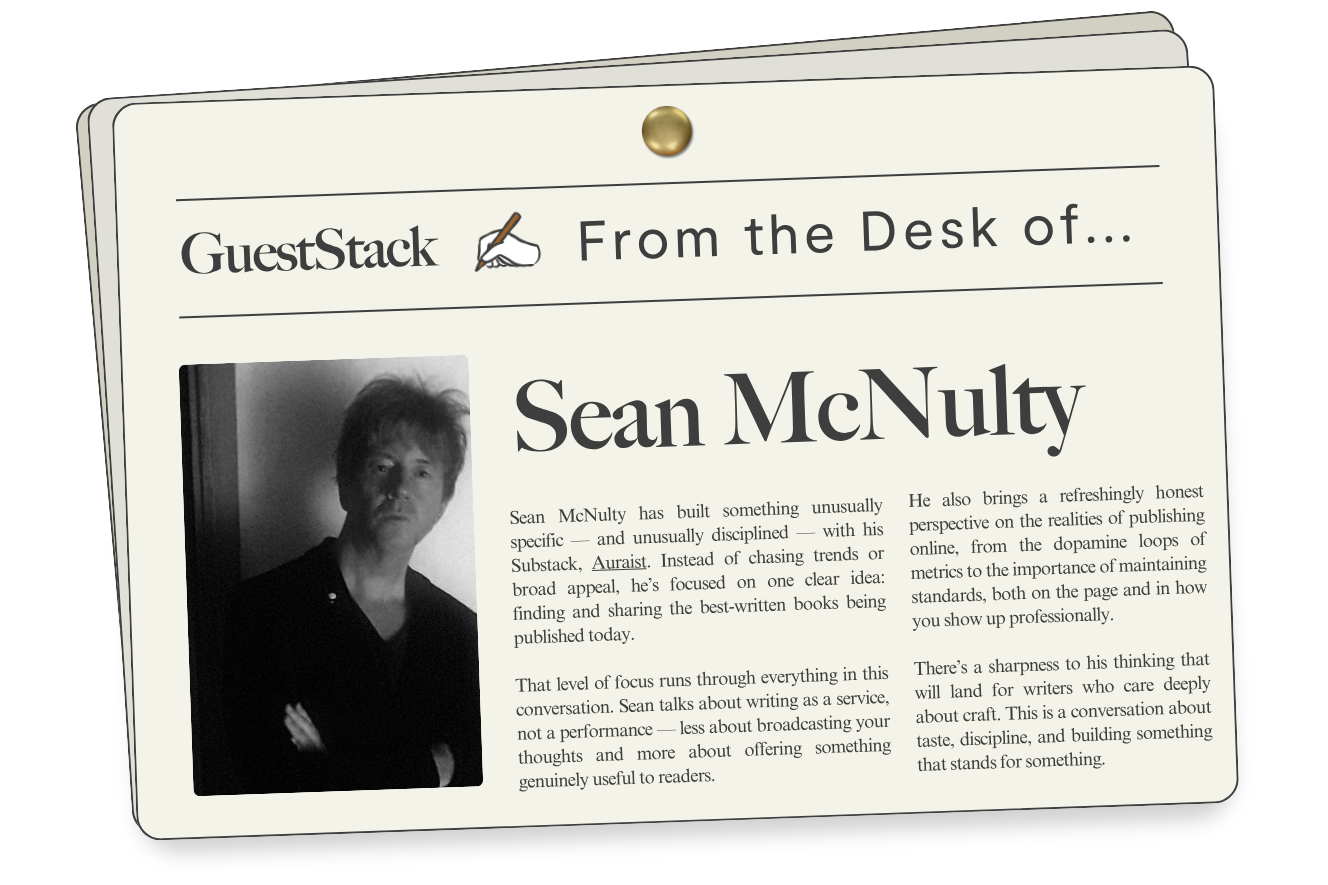
📚 Editor’s Note: Writing as a Service
Sean McNulty has built something unusually specific — and unusually disciplined — with his Substack, Auraist. Instead of chasing trends or broad appeal, he’s focused on one clear idea: finding and sharing the best-written books being published today.
That level of focus runs through everything in this conversation. Sean talks about writing as a service, not a performance — less about broadcasting your thoughts and more about offering something genuinely useful to readers. He also brings a refreshingly honest perspective on the realities of publishing online, from the dopamine loops of metrics to the importance of maintaining standards, both on the page and in how you show up professionally.
There’s a sharpness to his thinking that will land for writers who care deeply about craft. This is a conversation about taste, discipline, and building something that stands for something — even if it grows slower, and even if it’s a little out of step with the rest of the internet.
– Amy Suto
Editor & Curator of GuestStack
✍️ From the Desk of Sean McNulty
Where’s your desk these days — and what does it look like?
Couch in Madrid. I have a bad back so for all computer work I sit here and work off a large screen.
Currently flashing outside my window are the lights from the latest ambulance called for someone wheeled out of the oldster disco Golden. This happens about five times per week, roughly one dancer taken off to hospital every night.
Going by the queues outside, Golden holds around 200. So when they enter, the punters are accepting a one-in-two-hundred chance of hospitalisation. The place must be fantastic.
What does “making writing your job” look like in your world right now?
I make money through subscriptions to Auraist. We pick the best-written books from US and UK recent releases and prize shortlists, and while almost all of these picks are sent out to free subscribers, we do also pick what we feel is the best-written book of the month, and that pick’s sent out to paid subscribers only.
My satirical series The Demon Inside David Lynch: TV Drama’s Worst Fiasco has brought in a good number of subscriptions, particularly around the time of Lynch’s death.
We’ve featured in-depth articles on prose style and AI writing by writers such as Samantha Harvey, Paul Lynch, Stephen Marche, Eimear McBride, Tom McCarthy, Francis Spufford, Anna Della Subin, Jonathan Meades, Stephen Graham Jones, Donal Ryan, Simon Critchley, and Nicholas Dames. Paid subscribers can access the full archive of these pieces.
We accept submissions from our paid subscribers, and if the prose is up to the standard of our others picks, we feature them on the site.
So that’s what Auraist offers to paid subscribers, and that’s how I get paid. The surprise has been that any of this has worked at all. When we started my greatest hope for this point was maybe a couple of thousand subscribers and followers, but the total’s over seventy thousand now, and what that says about readers’ hunger for the highest-quality prose has been both surprising and reassuring.
What’s one lesson you wish someone had told you earlier about the business of writing and creating online?
The lesson would be: read The Hacking of the American Mind much earlier than you did.
Publishing online is of course horribly dopaminergic, and for me the unhealthiest aspect of doing so. How many people opened that last email, how many of those are new readers? Etc. A dirty buzz and a fairly low state of being.
I’d stayed away from social media completely in the decade before setting up Auraist. So the unfortunate truth is that more than anything I needed knowledge and tools to try to keep my head straight, or straighter.
The Hacking of the American Mind provides the knowledge about how modern life has wrecked our brain chemistry, especially our dopamine receptors. (As a bonus it may also accidentally explain the deterioration of contemporary culture and politics).
The prose is sometimes unimpressive, and the author leans too hard into chemistry-teacher-with-a-guitar, but to avoid the dopamine traps of publishing online (or offline), that book’s a good place to start.
How’s that for counterintuitive?
What’s your writing or creative routine like if you have one?
I mix creative work in amongst more administrative stuff for Auraist and my other projects, and vice versa.
I do this so I don’t get bored by long stretches of admin, and also because I think that tidy, disciplined, Apollonian admin mindset can be helpful in creative work, especially if you’re exploring extreme subject matter and psychologies.
Switching back and forth between right-brain and left-brain work throughout the day makes things feel balanced and (that word again) healthy.
I don’t know anyone else who works like this. It’s been frowned at by several experienced writers.
Was there a moment you realized, “Wait… I can actually do this”?
When we were able to publish a piece by Paul Lynch on the prose style of Prophet Song a couple of days before it won the Booker.
We only had a few dozen subscribers at the time, and that piece was what really kicked things off for us. Lithub licensed it and within days a number of well-known stylists were in touch offering their support.
The support from writers whose prose we admire has been one of the most gratifying things about Auraist.
What’s something you tried that didn’t work — and what did you learn from it?
Some of worst blunders will never surface anywhere, I hope.
Actually, would you mind if I respond with a blunder that some writers make when submitting work? I think this might be more useful to your readers than, say, the email I sent to a literary legend that contained certain typos that still make me cringe two years on.
This advice will sound really obvious: don’t be rude. Have some manners in your covering email. Don’t just say ‘Everybody loves this. Read it.’ and then end the email there. I receive a couple of emails of this type per month, from one demographic in particular, and it seems the authors just feel they’re too cool for manners.
Nobody’s too cool for manners.
What’s the best investment you’ve made in your writing life (time, money, or energy)?
Obsession always helps.
Auraist is a bestselling publication here on Substack that explores the best-written books out there — what were the ways you grew it? Anything out of the ordinary, or surprising to you?
One of the things that’s helped most is viewing Auraist as a service.
It’s rewarding to think of some of the writers we’ve published, and to have an audience for my own writing. But the core of the thing is putting in the time to identify something that’s of actual use to our readers: identifying not the best books but the best-written ones.
Too many writers and Substackers seem to view writing like after-dinner speaking: Behold my latest thoughts, world. Might be better to think of it more like pouring people’s wine for them, or passing them the trifle.
What’s something you’re currently obsessed with — and how is it influencing your writing?
Praiseworthy by Alexis Wright, the best-written novel I’ve read since we started up, and also the best. Angry, savage, very witty, wise, won some big prizes, almost flawless at the sentence level, and totally lacking in artistic and thematic cowardice.

👋 About Sean McNulty, This Week’s Featured GuestStack Writer
Sean McNulty worked as a nightguard at St. Patrick’s psychiatric hospital in Dublin. He now lives in Madrid, right beside Golden, where he edits Auraist, which picks the best-written books from recent releases and prize shortlists.
