


📚 Editor’s Note: Meet Jesse J. Anderson
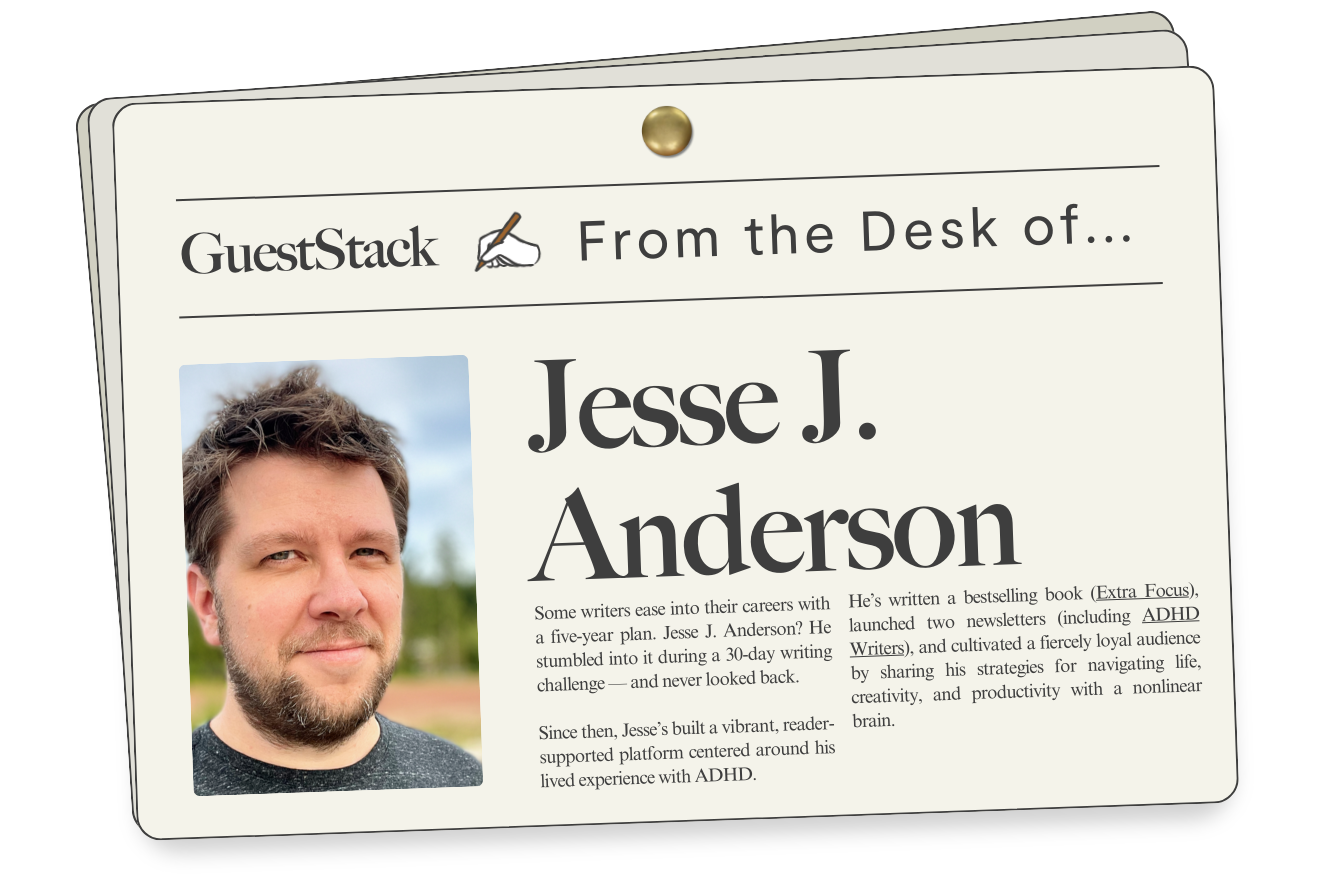
Some writers ease into their careers with a five-year plan. Jesse J. Anderson? He stumbled into it during a 30-day writing challenge — and never looked back.
Since then, Jesse’s built a vibrant, reader-supported platform centered around his lived experience with ADHD. He’s written a bestselling book (Extra Focus), launched two newsletters (including ADHD Writers), and cultivated a fiercely loyal audience by sharing his strategies for navigating life, creativity, and productivity with a nonlinear brain.
In this refreshingly candid GuestStack interview, Jesse shares why he quit TikTok after 60K followers, how body-doubling turned him into a believer, and the $300 split keyboard he’d replace in a heartbeat if it ever was broken.
If you’ve ever felt like your desk—and your brain—were both a bit too full, Jesse’s story is your reminder that creative chaos can still lead to clarity.
-Amy
Editor & Curator of GuestStack
✍️ From the Desk of Jesse J. Anderson
Where’s your desk these days — and what does it look like?
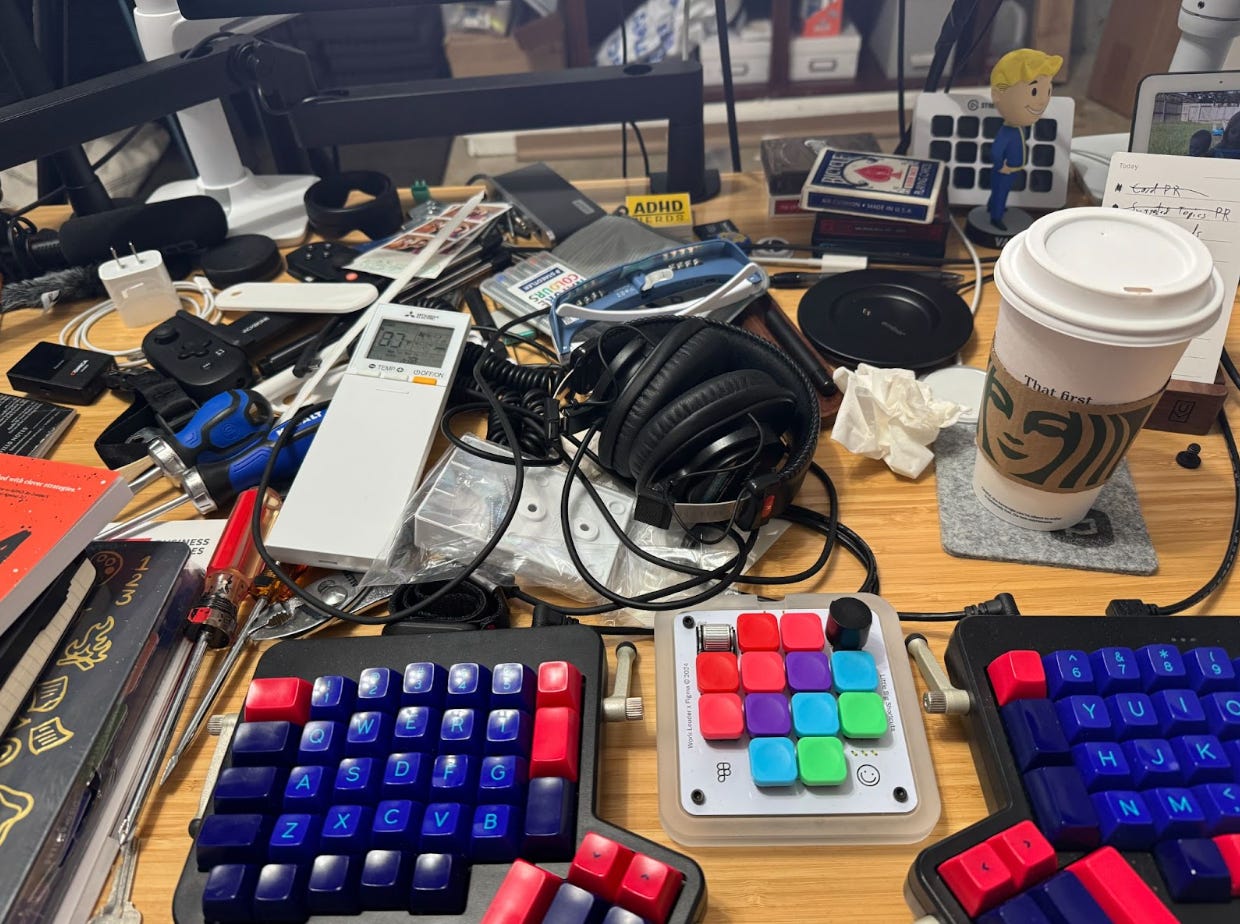
My desk is a lot like my brain, absolute chaos.
There are multiple stacks of books I really wanted to buy and haven’t yet opened, assorted coffee cups, productivity systems that have since been abandoned, assorted index cards full of good ideas I haven’t looked at in months, Field Notes of various sizes also full of good ideas I really need to revisit, cable adapters for devices I no longer own, and a Vault Boy bobblehead from one of my favorite video game franchises, Fallout.
I have a couple of great monitors (one is a fancy Apple Display) and a mounted dSLR and Shure MV7 microphone for podcasting and making fancy Zoom calls.
I also have an extremely nerdy split keyboard called an ErgoDox which I adore. It’s essentially a normal keyboard cut in half and using an ortholinear key layout. If something happened to it, I would buy a replacement the very next day, despite it costing over $300. In addition to being a writer, I do a lot of work as a frontend developer and consider this keyboard essential equipment.
This desk is located in my affectionately named “The Studio”, which is a large room built into our garage that used to be a workshop. It has no windows, so my second monitor is most often used simply for playing random nature videos (I especially like beach videos which remind me of my time living in California). It honestly feels a bit silly to have nature videos playing, but it helps me to escape feeling like I’m hiding in a windowless room in my garage.
What does “making writing your job” look like in your world right now?
I sort of stumbled into becoming a writer several years ago by joining a writing challenge that had just started called Ship30for30. The basic premise was to write something and ship it (i.e. post it publicly) every single day for 30 days. Through that challenge, I started to grow a following by writing about my experience with my ADHD diagnosis and how that affected my view of the world.
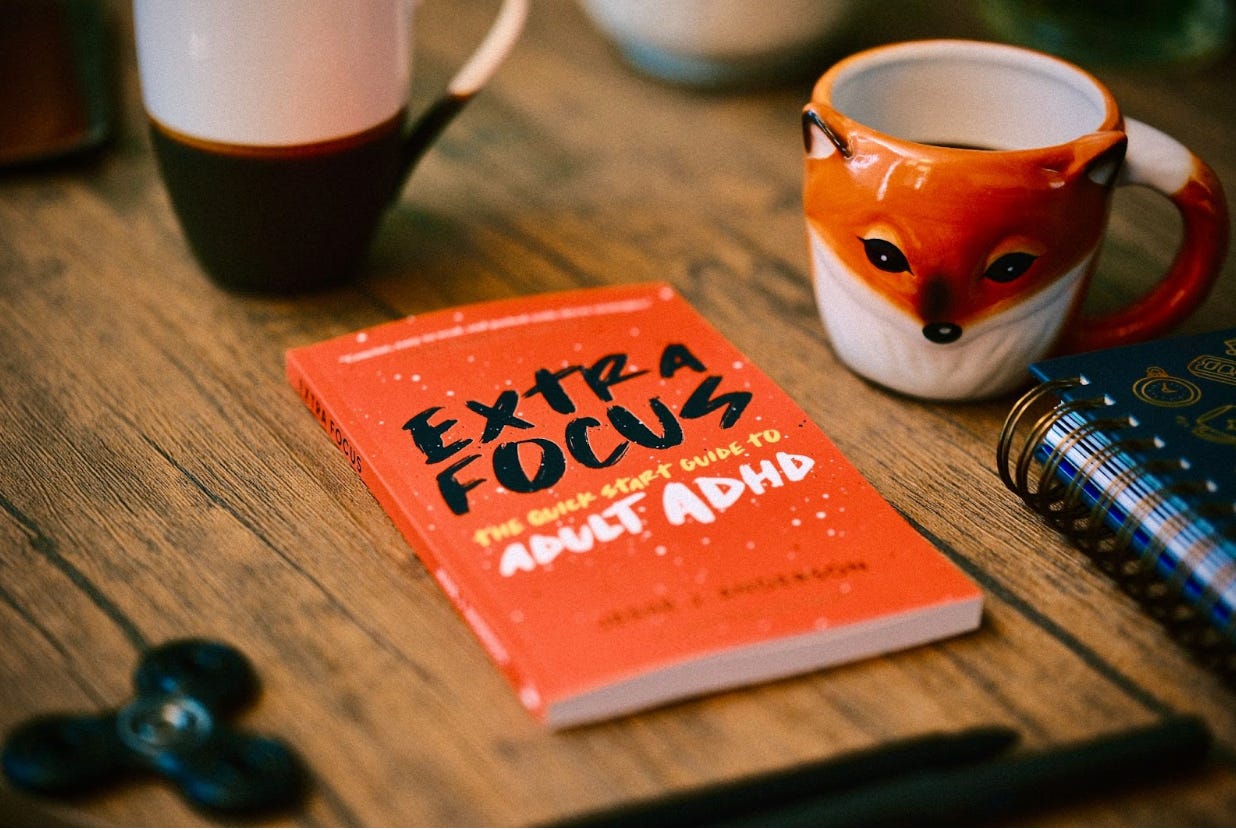
That led to me writing my first book, Extra Focus: The Quick Start Guide to Adult ADHD, which was the book I wish I had gotten when I first got diagnosed—a strategy guide to all the basics of ADHD and what it meant to live with it in the day-to-day.
It was self-published but did quite well, and is about to hit 25,000 copies sold.
In addition to my debut book, I write weekly about ADHD in my newsletter Extra Focus (extrafocus.com), and I also have a newsletter I write with my friend Meredith Carder called ADHD Writers (adhdwriters.com) that explores the combination of writing and having ADHD. Both of those have paid subscriptions for bonus content and some live Q&As and body-doubling.
And finally, I am working on my second book and currently exploring whether I want to consider going the more traditional route this time around. Self-publishing was great, and was quite lucrative, but I’m curious to explore what sort of deal might be available for a second-time author with a successful self-published title.
What’s one lesson you wish someone had told you earlier about the business of writing?
Write what you like to read. Don’t worry about how you think you’re supposed to write or obsess about following the rules. Your editor can worry about that later, and you can just ignore their suggestions if the “wrong” way reads better to you.
What’s your writing routine like — or do you even have one?
I’m a morning pages dropout that keeps trying (and failing) to make it work. Maybe one reason is that I’m not a morning person so I’ve found it hard to find the right time to make it a consistent habit!
Also, when you have ADHD it can be difficult to have consistent routines especially when they are meant to be connected with your creativity. My brain is always craving the new and novel, so I find that rather than having a consistent writing routine, I just have a giant playbook full of all sorts of random strategies that work sometimes, and then when they stop working I quickly drop them and move on.
Here are a few of them.
Stuck? Go for a walk (without headphones!)
Buy a nice pair of shoes that are your “writing shoes” and only put them on when it’s time to write
Overcome writer’s block by writing a pretend letter to a friend about what you’re trying to write about
Organize a mess of thoughts by writing down all your ideas (or chapter topics, or specific sentences) on index cards then sit on the floor and organize them into piles that are related and then sorting the piles in a way that makes some sort of narrative sense
Use timers rather than word counts (“write for 20 minutes” not “write 500 words”)
Was there a moment you realized, “Wait… I can actually do this”?
That first year after the writing challenge that started everything was all sort of a blur. I had no idea anyone would care about my writing, but as I continued to write, my Twitter following grew from about a thousand to five thousand, then ten thousand, and beyond. Follower counts aren’t everything of course, but that was the tangible thing that gave me that first belief that people actually cared about what I had to say and teach about ADHD.
What’s something you tried that didn’t work — and what did you learn from it?
Early on, I tried out TikTok and by all accounts it did work, surprisingly well! I was able to grow to 60k subscribers in a matter of weeks. But it very quickly destroyed my mental health.
I was thinking about “the next video idea” constantly. It had taken over my brain. I couldn’t focus on anything because I was addicted to trying to have the next hit TikTok video which was negatively affecting everything else. I made the call to quit, even while others said I was crazy to walk away from something successful because I wanted my brain back.
I like the advice of Derek Sivers: if I’m not a “Hell Yes” on some opportunity or decision—meaning it’s something I can’t imagine not doing—then I should be a no.
How do you find or create opportunities for yourself as a writer?
Serendipity through connections and good work. I like to give myself a lot of opportunities for luck to happen by connecting with people and putting myself out there.
I found that I had a lot of things I wanted to share about writing after going through the experience of writing my book Extra Focus, so I started the ADHD Writers newsletter as an outlet for that.
Similarly, I recently started a new podcast ADHD Founders (adhdfounders.xyz) with a couple of fellow ADHD business owners because I found that I wanted to share thoughts about running a business with some friends in the same boat.
For me it’s all about leaning into the things that energize me and light me up, and my experience has shown me that opportunities are much more likely to find me when I’m doing that than when I’m desperately trying to seek them out.
What’s the best investment you’ve made in your writing life (time, money, or energy)?
I read a lot of books on writing while working on my book, but the one that helped the most was Rob Fitzpatrick’s Write Useful Books. It wasn’t much of an “investment” but it made the whole process actually make sense and I referred back to it often while navigating the tricky little details of effective self-publishing.
What’s a piece of writing advice you’ve heard a million times… but you actually believe in?
Writing groups or body-doubling just simply works. I don’t know what it is, but hopping on a video call and telling them I’m going to write for 50 minutes and then staying on the call... there’s some sort of magic that makes me actually write for 50 minutes.
What’s something you’re currently obsessed with — and how is it influencing your writing?
Ooh, this is a really interesting question. I’m a big fan of video games and in particular I’ve always loved puzzle games. Not just any puzzle game though, something more like an open-world discovery puzzler, usually with a narrative and puzzles that are often hidden in plain site, requiring the player to take notes of things that won’t make sense until later in the game as you discover more.
Right now that game for me is Blue Prince, but a few previous games of this genre that I loved were Return of the Obra Dinn, Outer Wilds, Tunic, and Lorelei and the Laser Eyes. They are almost like an interactive whodunnit mystery game but usually even more complex.
As to how it influences my writing, I’m honestly not sure! I do love the idea of clever reveals and introducing delightful discoveries, though I feel there is less opportunity for that in non-fiction. Perhaps if I ever get to write my time-travel novel I’ve been tossing around in the back of brain, I can bring this influence into my writing more.

📚 Get Jesse’s Book: Extra Focus: The Quick Start Guide to Adult ADHD
Discover the keys to embracing your ADHD strengths and quirks with Extra Focus.
This book isn't a stuffy, clinical rundown of ADHD. It's more like a friendly chat over coffee with a good friend who gets it. We'll unravel some of the myths and mysteries of the ADHD mind, learn why most self-help strategies don't work for us, and how we can develop strategies that work with our brain instead of against it.
Written by an adult with ADHD for adults with ADHD, this empowering book provides the compassionate understanding and practical strategies you need to stop struggling and start thriving.
Jesse J. Anderson draws from his personal journey of being diagnosed with ADHD as an adult to offer encouragement, motivation, and strategies tailored for ADHD brains.
👋 About Jesse J. Anderson, This Week’s Featured GuestStack Writer

Jesse J. Anderson is the author of Extra Focus: The Quick Start Guide to Adult ADHD. He is a writer, speaker, ADHD advocate, and maker of things. Diagnosed at 36, Jesse writes about his insights and experiences living with ADHD in the weekly newsletter, Extra Focus, helping seventy thousand readers navigate their own ADHD journeys or better understand their loved ones. He also writes for ADHD Writers, a newsletter for writers with ADHD and cofounded Wavepal, an app that helps you be the friend you wanna be.
He is known for his humorous, relatable, and insightful posts about ADHD on various social media as @adhdjesse, and has been featured in publications including Huff Post, Today, and Wondermind.

❓ Want to Support GuestStack?
If you’d like to support your fellow writers and their work, I recommend sharing these GuestStack posts, subscribing to our featured writers’ Substacks or other newsletters, and buying their books if you feel so inclined.
Want to do more to support GuestStack? You can also upgrade to a paid membership on From the Desk of Amy Suto: Make Writing Your Job for $8/month or a discounted $80/annually, which comes out to $1.53/week, or even less if you use the link below:
Don’t want to become a paid subscriber? All good! I’m just happy you’re here, regardless of your subscription status. I hope you enjoy all of the free content I share with you weekly, from the free Sunday posts to GuestStack essays, poetry, interviews, and more.
Wishing you warm writing vibes,
-Amy
It always makes me happy when I see other writers whose bodies, minds, and natures don’t fit the writer stereotypes say the hell with it and figure out how to make what they’ve got work to their advantage!
🤩