


📚 Editor’s Note: Meet Kat Lewis, Writer Across Worlds
Kat Lewis’s work moves between worlds — novels, video games, classrooms, Substack — but what ties it all together is her fearless approach to storytelling.
I first connected with Kat through our From the Desk Substack community, and immediately loved how she combines deep craft knowledge with a real-world perspective on what it actually takes to make writing your job. Her newsletter, Craft with Kat, is full of actionable, no-nonsense advice (the kind I wish had been handed to me on day one).
Kat’s debut novel Good People is coming from Simon & Schuster in 2026, and in this GuestStack interview, she talks about everything from building sustainable writing habits to what Dungeons & Dragons taught her about pacing a story. Her journey is a reminder that success doesn’t come from following a straight line — it comes from writing your own map.
Enjoy!
-Amy
Editor & Curator of GuestStack
✍️ From the Desk of Kat Lewis
Where’s your desk these days — and what does it look like?
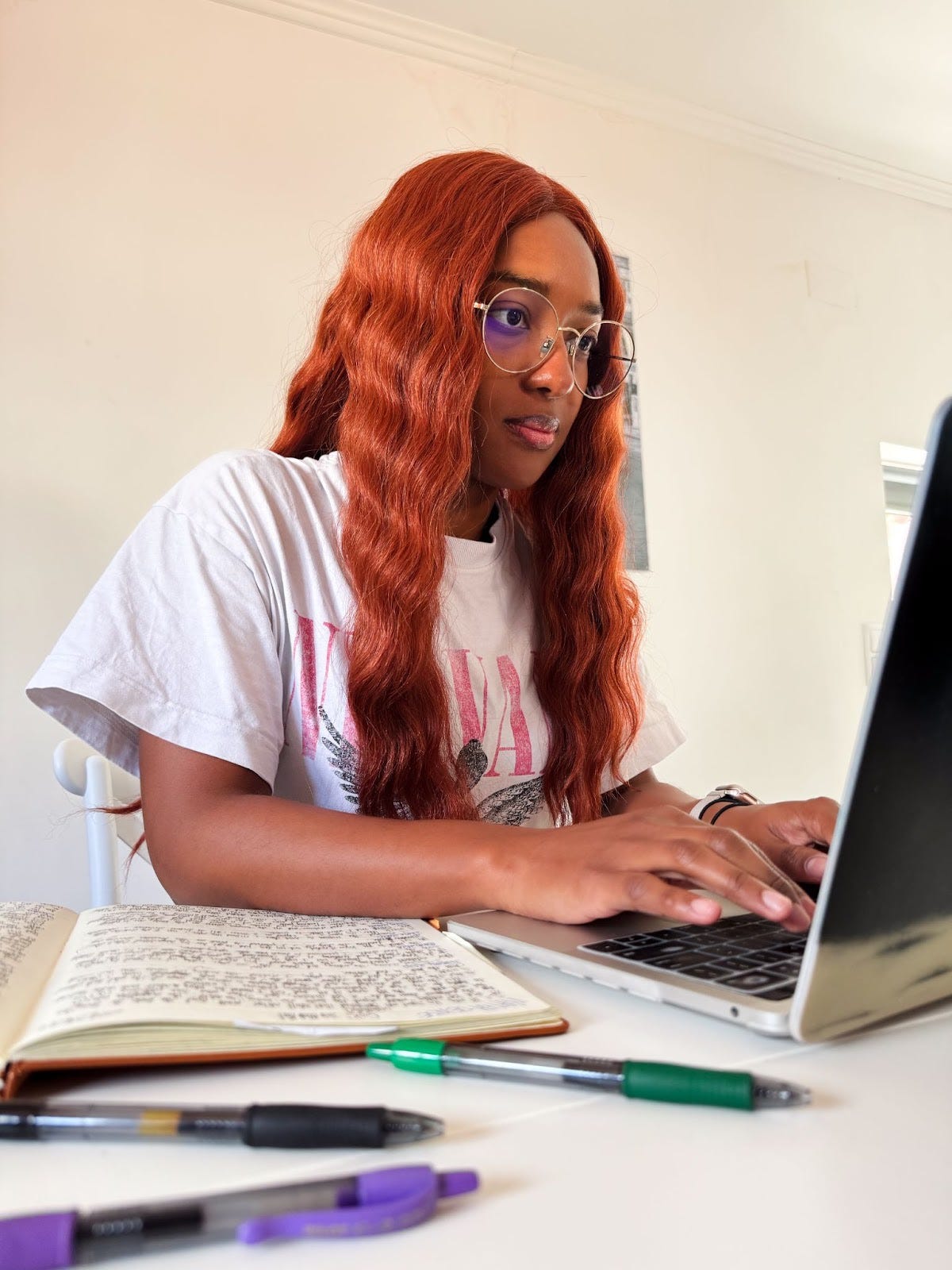
Right now, I’m writing to you from an apartment in Lisbon. I spent the last three years living in Seoul, South Korea where I worked as a video game writer. A few months ago, I moved back to the US to finish revisions for my debut novel, Good People. Since I’ve turned in my latest draft, I’ve been nomadic with my partner. This year, I’ve written in Tampa, Miami, Key West, Philadelphia, New York, Porto, and Lisbon so far. We’ll be visiting the Algarve next and then flying out to Ireland for a road trip around the country. After that, we’ll make a quick stop in Amsterdam to say hi to my cousin before heading back to the US.
Since I don’t have roots right now, my writing desk is pretty sparse. I’m traveling with my Macbook, a hardcover journal, and a copy of Martyr by Kaveh Akbar, which I’m loving so far.
What does “making writing your job” look like in your world right now?
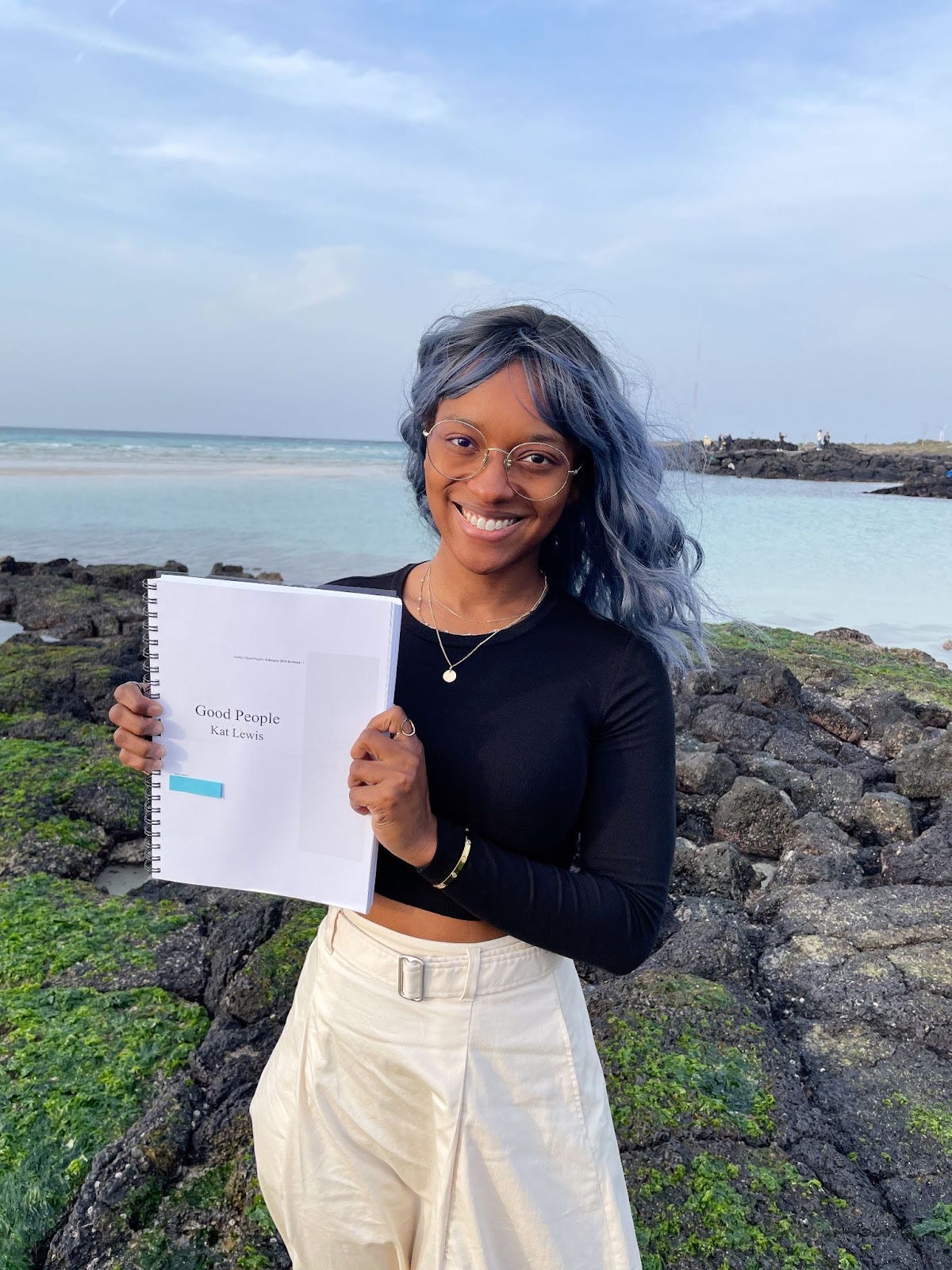
Outside of school, I spent the majority of my professional life in Korea working as a video game writer. Depending on where our games were in development, I was either designing narratives, writing game scripts, or working on marketing campaigns. Since I first moved to Korea for a Fulbright in 2018, my plan had been to live in Seoul doing whatever work gave me a visa until I sold my first book. I was incredibly lucky to be recruited for a day job that happened to align with my writing interests. Now that I’m back in the US, I’m using my savings from my book advance and game writing days to build a business around my Substack, Thinkific craft courses, and freelance editorial services. I have a year-long runway to work on both these ventures and my second book, but I’ll also be applying to tenure-track positions in creative writing departments this fall. I’m happiest when I’m writing or talking about writing, and I’ve found that teaching university is a fulfilling way to make writing my job.
What’s one lesson you wish someone had told you earlier about the business of writing?
Plot makes novels easier to sell in a western market. I write literary fiction, and I have two degrees in creative writing. I got a lot of value out of both of my programs, but creative writing academia very rarely teaches the science behind writing plot. My novel, Good People, originally died on submission to publishers because it didn’t have an external plot to serve as a vehicle to track its protagonist’s internal struggle and her eventual transformation. None of the courses in either of my programs taught us a concrete way to create plot in our stories. It wasn’t until I started writing for video games and had to study screenwriting again that I learned the mechanics of plot.
After reading books like Eric Edson’s The Story Solution and Jessica Brody’s Save the Cat Writes a Novel, I realized, oh, plot’s actually easy. Give your protagonist something concrete to win, stop, escape, or retrieve, and a person to get in their way (the main force of antagonism often works best in western storytelling if it’s another character), and a metaphorical or literal life-or-death consequence if they fail. Writing those steps out now makes it seem so obvious, but plot and story structure aren’t typically taught like that in creative writing academia. Once I added these key plot elements to Good People, I was finally able to sell it to Simon & Schuster.
Now as a professional writer, I look back on my time in school, and it’s wild to me that the concrete mechanics of plot are rarely taught. It’s like getting a degree in math and not learning algebra. Sure, in creative writing—like in any field—you’re not going to use every tool in your toolbox. But I think it’s important to learn how to use all the tools so that you have the option to use them. Now, whenever I’m teaching the craft of fiction, I prioritize teaching a concrete approach to plot so that students leave my class with this tool in their writing toolbox.
What’s your writing routine like — or do you even have one?
I’m the kind of person who thrives on routine. If I don’t have a solid routine, I become a total hedonist, and I’ll just watch The Vampire Diaries all day for the 200th time. Since I know how unproductive I am without a routine, I have a very rigorous approach to my writing life, and this approach changes depending on whether or not I have a full-time job. Since I’m writing full-time (read: unemployed and living on savings while building writing-related streams of income), my writing routine is what I call a 3-2-3 day. I start at 9 AM and spend three hours writing. Then I break for lunch. I give myself an hour to get food, eat, and scroll on my phone. After that, I spend the second hour reading to inspire my afternoon writing session. I’m back at my writing desk by 2 PM, and I write for roughly three more hours. I’m an obnoxiously goal-oriented person, so I set a long-term goal and then work backwards to break it down into monthly, weekly, and daily writing goals.
For example, let’s say I want to write the first draft of a 70,000-word novel in six months. To accomplish this goal, I have to write ~11,666 words a month, ~2,692 words a week, ~388 words a day. These goals are always just my bare minimum to help me manage burn out. If I’m writing for six hours a day, 388 words is so incredibly manageable. I track my daily word count in a chart in Google Sheets, and I gamify my writing with a race to finish much earlier than my 6-month deadline. But in those six months, life will happen, and some days it will be an uphill battle to write those 388 words, but because I planned ahead for this with a feasible, long-term goal, I feel empowered to just do the bare minimum that day and either prioritize (1) solving the problems that life is throwing at me or (2) resting by watching Vampire Diaries.
If I’m working a full-time job, I still set long-term goals, but I alter my expectations. For me, writing almost 400 words every day for six months while working full-time isn’t tenable. But I could write 200 words every day for a year. I’ve learned that I’m most productive if I set goals that are easily attainable. While working full-time, my writing schedule is a lot less rigid. I tell myself that I always have to meet my weekly goal. That means if I’m particularly drained after a work day, I don’t have to meet my daily goal that day, but I will have to make up for it on the weekend when my time is my own. So, that means my weekdays are flexible, but I might have to stay in to write when my friends are going out. Some sacrifices have to be made, especially while working a full-time job. But just like with everything else in life, it’s all a balancing trick.
Was there a moment you realized, “Wait… I can actually do this”?
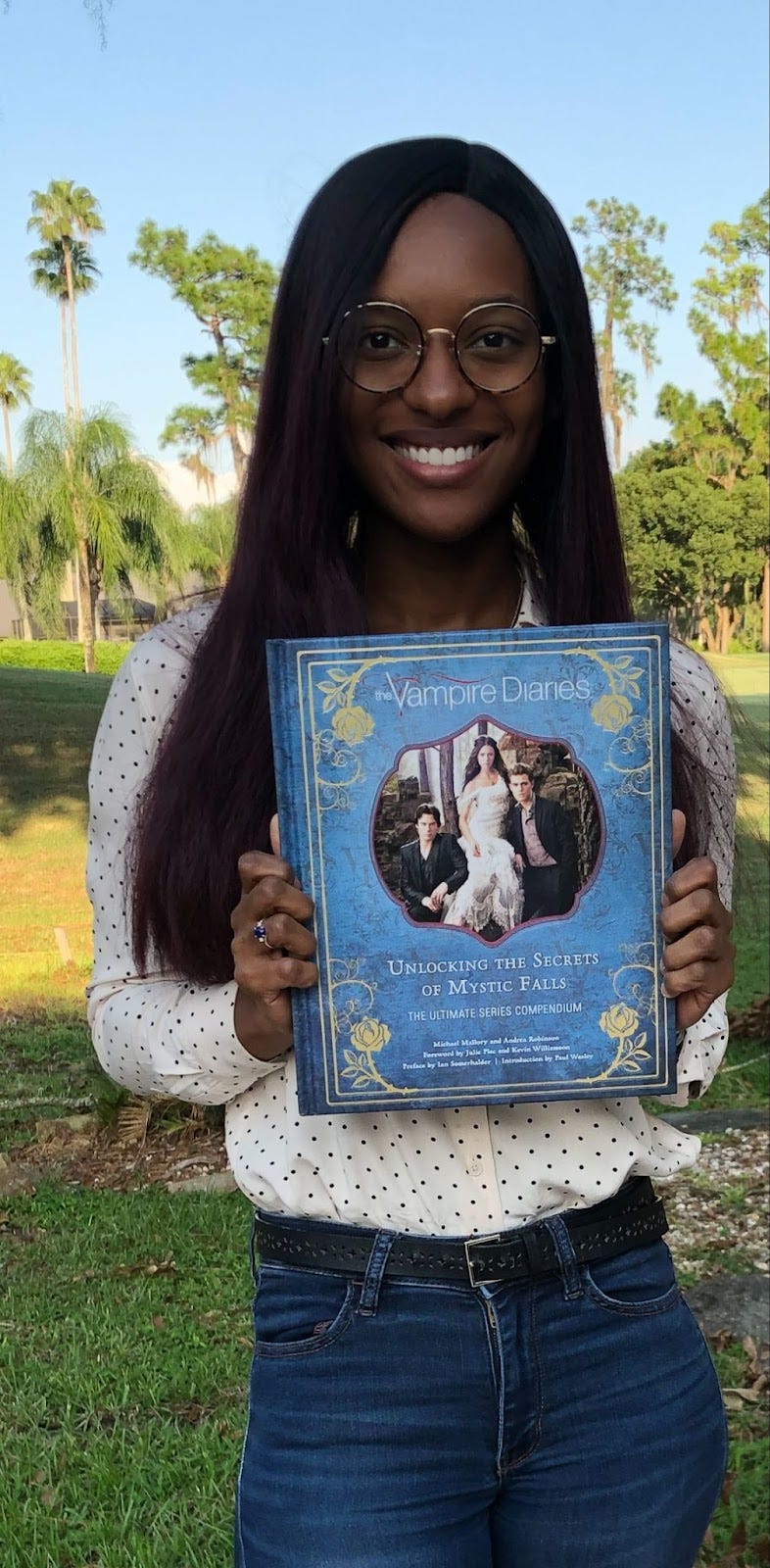
As with most things in my life, the answer goes back to The Vampire Diaries. I was fifteen when TVD premiered on The CW in 2009. New Moon’s theatrical release was three months away, and the pop culture obsession with vampires was in full swing. My best friend and I had planned on hate-watching TVD because there was “no way it could be as good as Twilight.” But as the credits rolled at the end of the pilot, I sat on the couch with my golden retriever in awe. The pilot alone was orders of magnitude better than Twilight, and I remembered thinking then at fifteen years old: “This is what I want to do with my life. I need to get as close to writing Vampire Diaries as possible.”
Seven years later, I graduated from college and got my first job in publishing as an executive assistant at a licensed book publisher. Three months into the job, I was taking minutes while my boss was on the phone with Warner Bros. Toward the end of the call, he mentioned that our Vampire Diaries book was “in trouble” because its editor had just left the company and no one else had watched all eight seasons of the show. Before this moment, I had no idea we had a Vampire Diaries book under contract. As soon as he hung up, I all but demanded that he give the book to me. This was the first book I edited. It was an important moment in my writing life because it affirmed in a small way that dreams do come true.
What’s something you tried that didn’t work — and what did you learn from it?
Even though working on the Vampire Diaries book was an important moment in my writing career, I quickly learned that working in publishing was not for me. When I was twenty-two, I initially wanted to become a screenwriter. In college, the advice my film classes and our industry visitors gave to us generally said this: “Get on someone’s desk and work as an executive assistant for a few years while you network and write your screenplays.” When I graduated from college, I applied to assistant jobs in both the film and publishing industries with the goal of getting any kind of executive assistant experience in order to eventually pivot to “the desk” of someone in the film industry. I landed the publishing job three months after graduation and immediately discovered that I don’t have the personality, temperament, or maybe just plain patience required to be an assistant in any industry. This discovery meant that “getting on someone’s desk” and paying dues to break into the film industry wasn’t going to work for me, so I had to pivot.
I asked myself: what do I really want to do at the end of the day? I wanted to write stories. I didn’t really care if the medium I wrote in was screenwriting or prose. Since the screenwriting path my college courses had laid out for me wasn’t sustainable, I decided to pivot to novel writing and get an MFA in fiction. But I had just moved from Tampa to the Bay Area, and I was broke, only making $37K and paying rent in Berkeley. I didn’t have the funds to move to just any MFA program in the country, so I only applied to one program, the closest one to me, which happened to be at the University of San Francisco. I got lucky and was accepted into the program. But between the cost of the program and the cost of living in the Bay Area, I had to work three jobs to support myself while being a full-time student and trying to write Good People. When this financial situation became too much, I transferred to a fully funded program in my hometown, knowing that I could live with my parents and save money while I finished my degree at the University of South Florida.
The biggest lesson I learned is that a creative career is not clear-cut and linear like other career paths. Learning when to quit and pivot was the most important lesson I learned in my twenties. At the end of the day, my ultimate goal was to write and publish a novel. Whenever something significantly hindered me on my journey to completing this goal, I pivoted. The short-term pain of quitting something unproductive was always worth the long-term progress I’d make toward my writing and publishing goals.
How do you find or create opportunities for yourself as a writer?
Sharing my work online has totally changed my life. I got into the habit of submitting short stories, poems, and essays to literary magazines when I was a freshman in college. This habit helped me build up two important things early on in my writing career: (1) a tolerance for rejection and (2) a portfolio of published work. I shared my writing portfolio on both LinkedIn and my own personal website. I also built up a modest following on Twitter (back when Literary Twitter was a thing) by sharing my publications and documenting my writing process in my tweets. Sharing my work online led to agent solicitations before my novel was even finished, editor solicitations from major publishers, and a South Korean video game developer recruiting me as a game writer.
Were most of these opportunities driven by luck? Yes, but luck is opportunity meeting preparedness. Showing my work online showed agents, editors, and industry recruiters that I was already prepared for the role they were looking to fill. If anyone is interested in showing their work online but doesn’t know where to start, I recommend reading Austin Kleon’s book, Show Your Work! It’s a quick introduction to best practices for building an online presence as a writer or artist, and it’s totally transformed how I think about social media.
What’s the best investment you’ve made in your writing life (time, money, or energy)?
1. Teaching myself how to write plot by reading The Story Solution and Save the Cat Writes a Novel.
These books also teach outlining techniques. A lot of novelists and short story writers (myself included) are resistant to outlines, but writers for most other media (video games, television, film, etc.) have to use outlines to some extent. I got over my outline resistance by asking myself: do novelists know something that TV writers and game writers don’t? Or do writers from these more profitable industries know something that novelists don’t?
2. Learning how to write effective personal statements.
Thanks to this skill, my writing has received support from the Fulbright Program, summer writing workshops like the Sewanee Writers’ Conference and Mendocino Coast Writers Conference, and other university fellowships. These programs have given me funding to write full-time, opportunities to receive professional feedback on my book, and the time and space to build connections with other emerging writers.
3. Creating a consistent, independent writing habit.
When I was an MFA student, I quickly realized that if I only did the coursework for the degree, I wouldn’t leave the program with a query-ready novel, so I created an independent writing routine.
When I was writing for video games, a lot of my day-job work filled my creative well, but I didn’t want to lose sight of my novel writing goals, so I needed to maintain a consistent writing habit that was independent of my day job’s creativity.
What’s a piece of writing advice you’ve heard a million times… but you actually believe in?
“Write every day” works for me. It can be classist advice when it’s given without acknowledging the diverse familial or financial situations writers might be in. But as a young person with no children or other dependents, writing every day is feasible for me and my circumstances. For me, “write every day” doesn’t mean I’m literally writing every single day of my life. It means that I have a plan for my writing life at all times. That plan comes in the form of a feasible writing schedule that I can adjust to (1) ensure I’m making progress on my writing goals and (2) make room for other important things in my life. “Write every day” means “make writing a priority on a daily/weekly basis.”
What’s something you’re currently obsessed with — and how is it influencing your writing?
Dungeons & Dragons 100%. I’ve been a long-time D&D player. During the height of the pandemic, my friends and I played on Discord twice a week and kept campaigns going for the last five years. I recently DM’d my first one-shot game, and those two hours of leading my players through my story taught me more about conflict, storytelling, and pacing than either of my creative writing degrees. Keeping players engaged and entertained is so similar to keeping a reader engaged, but since the game consists of live storytelling with live feedback from my audience, I’m a lot more willing to “cut to the good stuff” and let go of the self-indulgent storytelling that’s only interesting to me as the writer. I’m revising my second novel now, and my goal is to embody this audience-first attitude in my daily writing practice.
If anyone is curious about D&D and doesn’t know where to start, I recommend checking out the Dungeons and Daddies podcast. Dungeons and Daddies follows the story of four dads who are transported from our world to the Forgotten Realms and must save their sons from imminent peril. Start with Season 1. This show is a great introduction to D&D and has some of the funniest storytelling I’ve ever experienced.
📚 Kat’s Upcoming Book: Good People
Jo Tope’s birth mother left her in a high chair in the neighbor’s house and never came back. This is how the Topes, a Black family of four, adopted a white baby.
Good People follows Jo Tope, a habitually drunk college student who desperately wants to become white. Growing up with her identity split between the Black family that raised her and the white schools she attended, Jo always thought that college would be her chance to escape her past and fully embrace whiteness. Now, a junior at Johns Hopkins University, she pursues a Rhodes Scholarship, believing that a graduate degree from Oxford is her path to becoming a “regular white person.” But when her alcoholic tendencies threaten her personal relationships and her chances at the Rhodes, Jo must learn that whiteness will not save her before she loses her academic future and the people who matter most.
👋 About Kat Lewis, This Week’s Featured GuestStack Writer
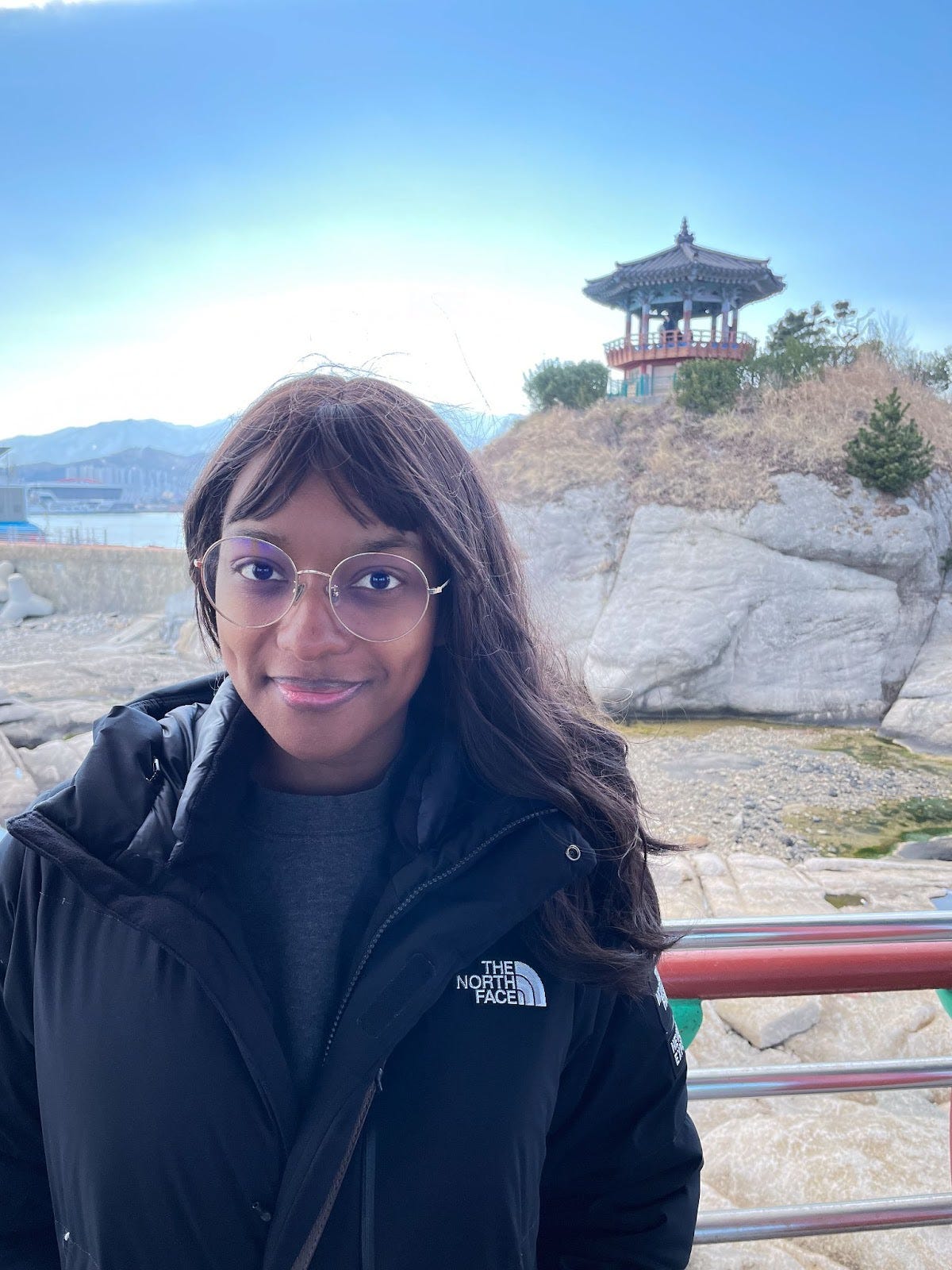
Kat Lewis is a fiction writer and video game narrative designer based in Tampa. She is the founder of Craft with Kat, a bestselling Substack newsletter with practical craft lessons for writers. She holds degrees in creative writing from Johns Hopkins University and the University of South Florida. Her debut novel, Good People, is forthcoming from Simon & Schuster in 2026.

❓ Want to Support GuestStack?
If you’d like to support your fellow writers and their work, I recommend sharing these GuestStack posts, subscribing to our featured writers’ Substacks or other newsletters, and buying their books if you feel so inclined.
Want to do more to support GuestStack? You can also upgrade to a paid membership on From the Desk of Amy Suto: Make Writing Your Job for $8/month or a discounted $80/annually, which comes out to $1.53/week, or even less if you use the link below:
Don’t want to become a paid subscriber? All good! I’m just happy you’re here, regardless of your subscription status. I hope you enjoy all of the free content I share with you weekly, from the free Sunday posts to GuestStack essays, poetry, interviews, and more.
Wishing you warm writing vibes,
-Amy
So much food for thought. Thank you to Kat for sharing her journey and advice. I really appreciated this gem--"Luck is opportunity meeting preparedness."
As per usual, my local library is going to be seeing me pick up yet another book lol. This time "Show Your Work" by Austin Kleon. And the summary for Kat's book, "Good People," looks intriguing. Is there anywhere I can sign-up for notification when it comes out?
Loved reading about your journey Kat! And I agree, the creative path is not linear. My career seemed to move forward and backwards and up and down before I finally found my flow as a freelance copywriter and Substacker. I'm grateful for ALL the detours though, as they taught me valuable lessons I apply in my work.