


📚 Editor’s Note: Rosie Spinks on The Beauty of Doing Less
Rosie Spinks has built a career most journalists dream of—bylines in The Guardian, The New York Times, Slate, Vice—but chose to walk away from it all in favor of something quieter, slower, and far more intentional: writing on her own terms. Her bestselling Substack — What We Do Now That We’re Here — is a poignant meditation on topics like work and friendship.
In this week’s GuestStack, Rosie shares what she’s learned across 15 years in media, why her most successful strategy was “doing less,” and how she separates her creative writing from her money-making work to protect her craft. Whether she’s working from a blanket-covered café deck or squeezing in Pomodoro sprints between parenting duties, Rosie’s writing life is grounded, thoughtful, and fiercely self-directed.
This is a must-read for anyone building a long-term creative practice — especially if you’ve ever wondered whether it’s okay to opt out of the algorithmic rat race and just… write.
-Amy
Editor & Curator of GuestStack
✍️ From the Desk of Rosie Spinks
Where’s your desk these days — and what does it look like?
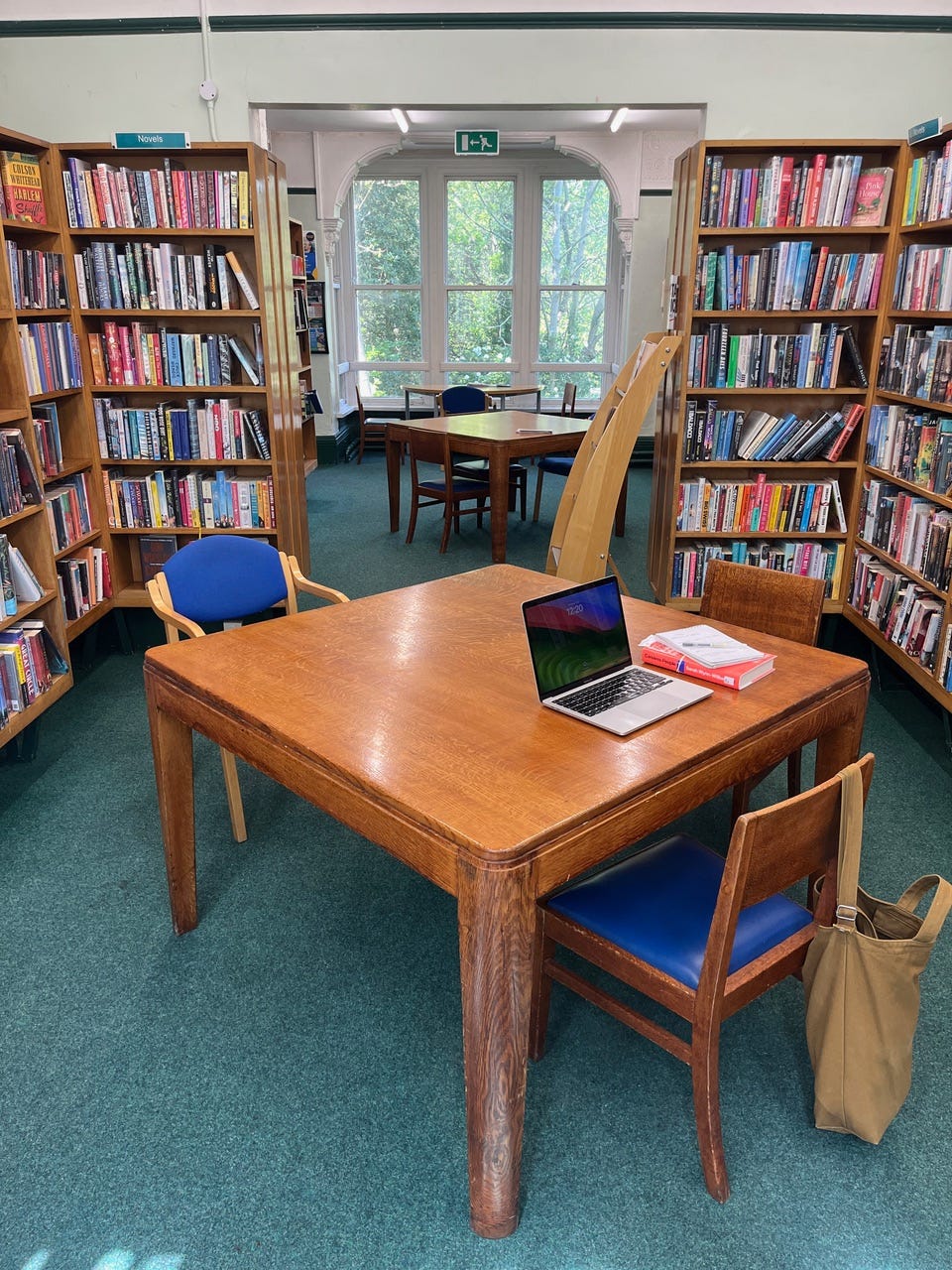
I live in Leeds, UK with my husband and son. Officially, I “work from home” and I even have a nice desk there. But unofficially, I almost always have to leave the house to get my best writing done. Small public libraries are my favorite places to work, or coffee shops. My current favorite is an outdoor cafe with a big deck and blankets on the chairs. The owner is often outside smoking a cigar in the middle of the day. The vibes are good, and so is the cannoli.
Wherever I am working, you will always find two things next to my laptop: a Muji 0.5 gel pen and a spiral-bound reporter’s notebook. I have filled dozens of these notebooks over the years with my daily to do lists, notes from calls, and scattershot ideas. I find it comforting to have something tangible as a record of all my days.
What does “making writing your job” look like in your world right now?
I am one of those nerds that wrote my first article for the student newspaper in my first semester of university and was like: “Yep, this is it for me.” Since then, I’ve earned money from writing in a lot of ways. From cobbling together an income as a freelance journalist (while also working a million odd jobs on the side) in my early twenties, to finally securing full time, salaried journalism jobs in my late twenties, wondering if that meant I’d finally “made it,” as a writer. I didn’t yet know there is no such thing.
In late 2020 I quit my last full time journalism job, stopped pitching to other outlets completely, and decided to foreground Substack as the home of my creative writing. After a decade of burnout and trying to play “the game” with ever-changing rules and business models, I didn’t want to do it anymore. I just wanted to write what I felt like writing and see what happened.
I now earn money from my Substack, but it is not my only source of income. I do editorial consulting work, content writing, ghostwriting, and help other people and brands with their newsletters. All of my “money” work is not bylined, and I don’t ask it to creatively fulfill me, though I often enjoy it. Separating my creative work (what I really want to write) from my money work (the stuff that brings in a reliable income) is one of the most healthy and generative things I’ve ever done in my creative and professional life. I really recommend it.
What’s one lesson you wish someone had told you earlier about the business of writing?
No one platform, publication, or viral success will change your career. Please stop believing this. What works is focusing on the writing, showing up for it as a sustained practice that is removed from the outcome, and closing the gap between what you want to say and what readers want to hear. I have been writing professionally for 15 years — for major outlets in the US and UK and in my own blogs/newsletters — and yet some people still seem to think that I found rapid success on Substack. This couldn’t be further from the truth. I have been building this skillset, this audience, this voice for years. (I started a personal newsletter on TinyLetter in 2016.) If you just started, for the love of god have some patience and enjoy the process a bit. Trust us old, tired digital media people when we tell you: Substack won’t be around forever. Something will replace it. Just keep writing through it all, and one day you can take your audience to the next shiny, buzzy place.
What’s your writing routine like — or do you even have one?
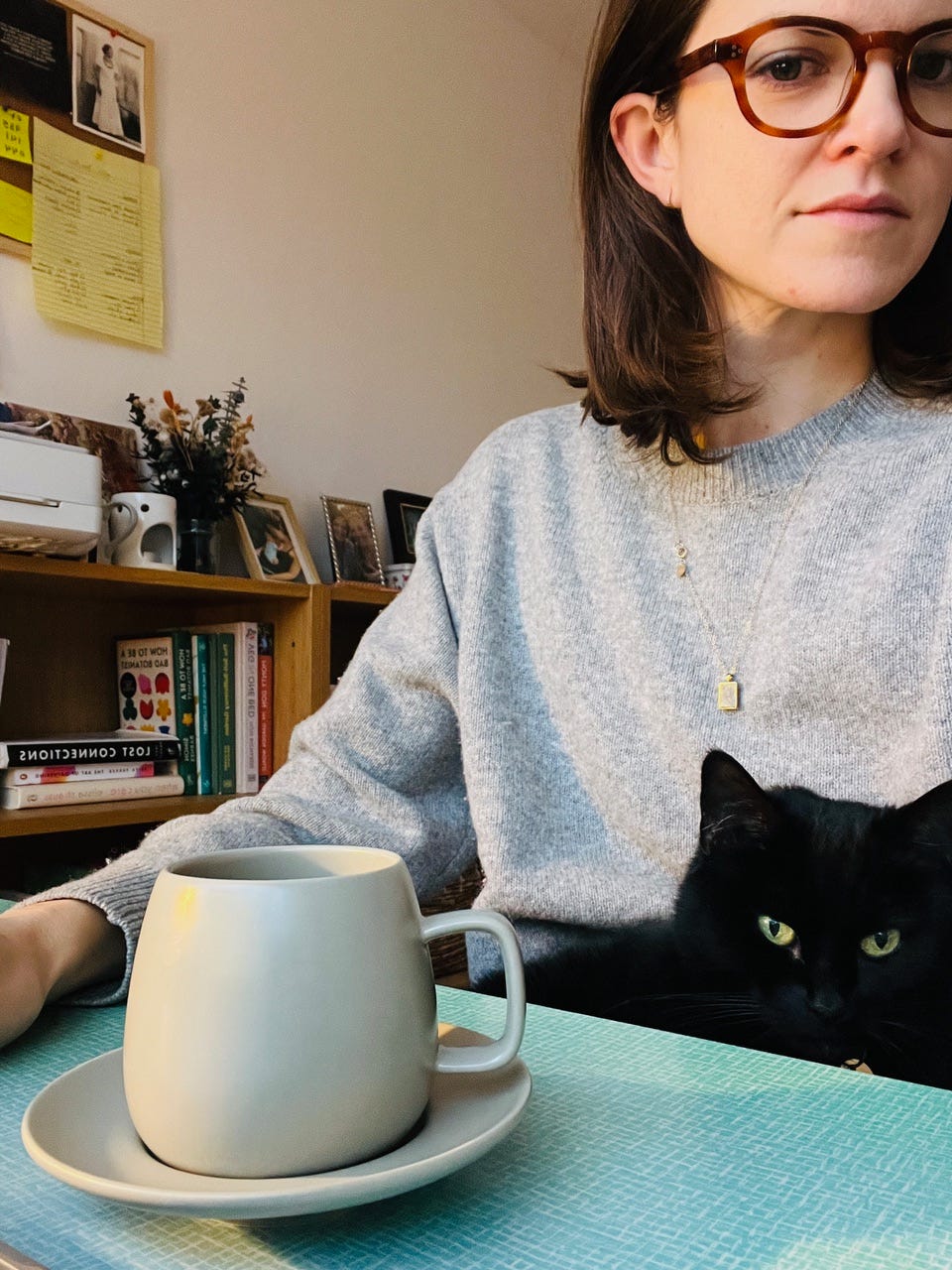
When you become a mom, any romantic notions of writing routines disappear. I have three days of childcare a week, and I have to fit a lot into that time. Writing from Friday to Sunday is largely out of the question, which I find hard. But on the upside, being a mom makes me ruthlessly effective at getting shit done. I waste less time on the internet, and I basically never have writer’s block — by the time I have time to properly sit down and write, I am fired up.
However, I try to not abandon the writing I most want to be doing during really busy times. If I am working on a writing project that has no real deadline or urgency (in other words, no one is paying me to write it but I want to make progress) I commit to working on it for 25 minutes a few days a week. It’s enough time to build some momentum if you commit to it 3-5 days a week, but it’s also short enough that you can usually convince yourself to squeeze it in somewhere. (If you can’t find 25 minutes, delete all social media, including Substack, from your phone). I use the pomodoro timer and put “25 minutes” as an item on my daily to-do list. It works.
Was there a moment you realized, “Wait… I can actually do this”?
As a freelancer, when I got my first assignment for The Guardian, I was like “okay wow this is happening,” and I went on to contribute to them for years. As a staffer, when I published a longform investigative piece that got lots of traffic and media attention, I thought “this is the kind of thing I always dreamed about doing.” I’ve been in the Substack phase of my career for five years now, and in some ways that’s because I gave up on the idea of “making it” altogether. But when I consider the fact that I get to write about whatever I want, lots of people respond to it, and some of them even give me money for it, I kind of can’t believe it. If you’d told me ten years ago that Substack or personal newsletters would occupy the place they do in the media ecosystem, I wouldn’t have believed you. But I still would’ve written one because I enjoy it.
What’s something you tried that didn’t work — and what did you learn from it?
Sending too much writing out into the world. When I worked in the digital media grind with a staff job, I had to publish something every single workday. It was exhausting, and I do regret a lot of what I published – if for no other reason than I know a lot of it could’ve been better if I had more time to work on it!
Sometimes I feel like the only Substacker who is out here encouraging people to do less. People are overloaded with content on this platform. Plus, it’s really hard to push out high quality writing on a predetermined schedule. When I give advice to new starters, I am always saying: DON’T overcommit to writing weekly or more. That is a lot. The writing will suffer and your readers will notice.
My favorite piece of feedback I get from readers is when they say “I always open your newsletter when it arrives, because it doesn’t arrive that often.” That feeling of intentionality is something you can cultivate, and it builds trust with your reader. I only hit send when I really have something I want to say, and my reader knows that. I feel like everybody wins that way.
How do you find or create opportunities for yourself as a writer?
I recently wrote a piece about how relationships, not for-profit corporations, are the only real source of job security which answers this question at length. Here is a quote from it:
“It’s become a point of pride for me that literally all of my freelance writing, editing, and consulting work comes from a network of relationships I’ve amassed over the last decade and a half. My CV and resume have never been impressive or pedigreed enough to get past a cold application portal, so I’ve been forced to create a career where I don’t need to apply for things in that way. Operating this way creates a different kind of security. Unlike an impressive job, it’s very unlikely that all your professional and creative relationships will fire you on the same day. I’ve learned that if I am generous and collaborative with people — especially when things are going well for me — they’ll often do the same for me down the road.”
What’s the best investment you’ve made in your writing life (time, money, or energy)?
I graduated university in 2011. I got rejected from an environmental writing fellowship at Middlebury College in the US that I was sure I would get. A lot of my friends were going to graduate school for journalism because, well, it was something to do. There were not a ton of jobs otherwise. Instead, I moved to London from California (I am a dual citizen). I lived in a highly questionable flat where I shared a room with two other girls from Brazil. I worked in a terrible restaurant in Covent Garden, found another magazine internship, and started freelancing. The first piece I got commissioned was about watching the 2011 London riots from the second floor window of that awful flat.
In other words, I spent the first half of my twenties investing in my own life experience, and I can’t tell you how valuable that was. (I also realize it was a privilege.) I had the energy, ambition, and willingness to make it happen, and I’ll always be proud of the version of me that went all in — and had the good sense to not go into further student loan debt. Shiny institutions and pedigree do not make you a good writer, being out in the world and paying attention does.
What’s a piece of writing advice you’ve heard a million times… but you actually believe in?
I’m going to tell you the opposite: Something I don’t believe in. When I was a reporter, it was seen as a kind of amateur or unserious to write in the first person. You were supposed to write with the authoritative voice of a journalist. Editors would often push back and say, “You don’t need to be in here.” I took it on board at the time, even though I had a suspicion that it was quite gendered advice, and I noticed the pieces I wrote in first person tended to do better.
Well, ten years or so later, I can say I profoundly disagree. And I think that’s becoming more the case with AI – people want to relate to a writer on a human-to-human level because that “authoritative voice” is increasingly an LLM. Of course, you have to be judicious with the first person. I’m not live-blogging my life over here. What you leave out is as important as what you put in. I don’t want the reader to come away thinking about my life, but rather, their own.
What’s something you’re currently obsessed with — and how is it influencing your writing?
I just finished watching The Pitt, and wow, I am completely obsessed with that show. The writing on the show is so good that medical professionals are talking about how accurate it is. (Also, Dr Robbie is a dreamboat). I don’t have any interest in writing fiction or screenplays, but I’ve still been fascinated to learn how the writers got the emotional and medical truth of the show so right. Here is a good interview about it.

👋 About Rosie Spinks, This Week’s Featured GuestStack Writer
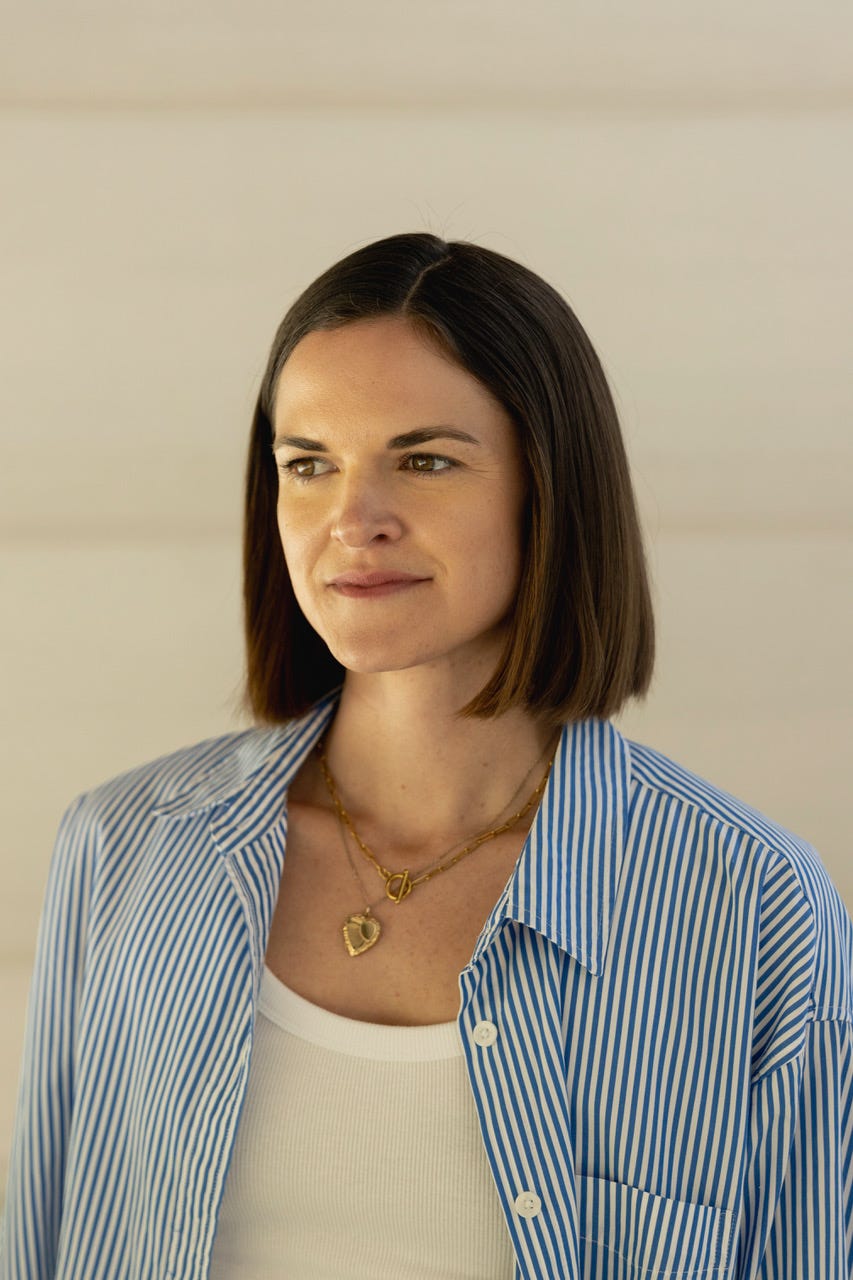
I am a writer, editor, and editorial consultant with 15 years of experience working in media, journalism, and content. My work not only helps people figure out what their story is – but also how to make other people care about it. My expertise is informed by a decade-plus journalism career writing for some of the world’s leading publications: The Guardian, The New York Times, Vice, NPR, Slate, Atlantic Media (Quartz), Outside Magazine, Sierra Magazine, and many others. My own newsletter, What Do We Do Now That We’re Here? Is a Substack Bestseller and has been featured in the New York Times, New York Magazine, Outside Magazine, and Harper’s Bazaar.

❓ Want to Support GuestStack?
If you’d like to support your fellow writers and their work, I recommend sharing these GuestStack posts, subscribing to our featured writers’ Substacks or other newsletters, and buying their books if you feel so inclined.
Want to do more to support GuestStack? You can also upgrade to a paid membership on From the Desk of Amy Suto: Make Writing Your Job for $8/month or a discounted $80/annually, which comes out to $1.53/week, or even less if you use the link below:
Don’t want to become a paid subscriber? All good! I’m just happy you’re here, regardless of your subscription status. I hope you enjoy all of the free content I share with you weekly, from the free Sunday posts to GuestStack essays, poetry, interviews, and more.
Wishing you warm writing vibes,
-Amy