


📚 Editor’s Note: Welcome to the From the Desk Interview Series
I first discovered Dr. Hanne Blank Boyd not through her impressive bibliography and career as an author, but because she’s a subscriber here — part of this little orbit of talented writers we’re building together on From the Desk of Amy Suto.
I also chose Hanne to be the inaugural interview here on the GuestStack column because her Substack, Reasons Not to Quit, immediately pulled me in. It’s part motivation, part masterclass — and her recent series on research for writers has become one of the most useful things I’ve read lately.
I’m thrilled to bring you this interview, which dives deep into what it actually looks like to build a creative career without shortcuts, without formulas, and sometimes… entirely by accident.
I hope it gives you as much insight and encouragement as it gave me.
-Amy
Editor & Curator of GuestStack
✍️ From the Desk of Dr. Hanne Blank Boyd
Where’s your desk these days — and what does it look like?
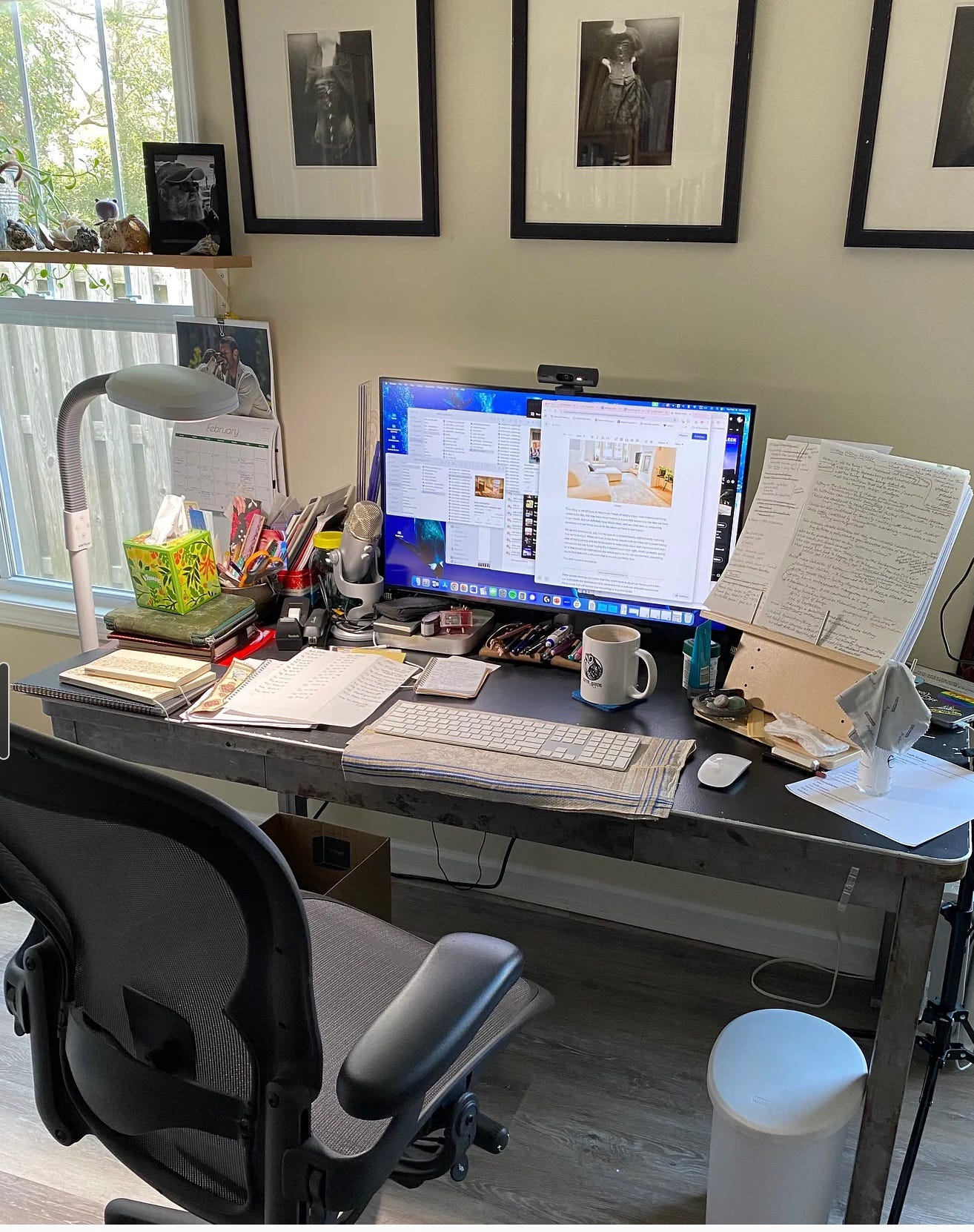
My desk is a ridiculously heavy industrial steel office desk made by the Peerless Steel Equipment Company of Philadelphia in the 1940s and rescued from the side of the road somewhere in Atlanta in the early 2000s. It stands between two windows in a north-facing wall of my house in a small town at the end of a road on the sandy right-hand edge of North America, roughly where the Cape Fear river merges with the Atlantic Ocean. Out the left window there is a longleaf pine tree in which a murder of gangly teenaged crows meet daily to argue about crow business. If I look out the right-hand window at this time of year, I may glimpse seabirds like laughing gulls or brown pelicans flying between the river delta and the nearby barrier island or, if I’m lucky, a flock of American white ibis headed for the salt marshes. Two dogs, ages 18 and 2, are usually supervising me from the dog beds near the wall of bookshelves.
On the desktop, the fixed landmarks are a moderately sized pottery bowl of pens and pencils, a large monitor screen, and a good old fashioned wooden book and copy stand -- the Atlas Standard Book Holder is a life- and neck-saver if you do a lot of research or editing.
What else is there varies. Sometimes it’s my computer keyboard and mouse, if I’m working electronically. Sometimes it’s a manual typewriter, which I often use for drafting since I am fond of them and they are 100% devoid of distractions. Sometimes it’s paper and pencil or pen. When I’m editing, there are 5-10 sharp pencils on the desk, along with a KUM long-point dual blade manual pencil sharpener (excellent value for money, as you can replace the blades when they get dull). I edit on paper copies, I just don’t do it as well on a screen, so several of the pencils will be double-ended, two-color editing pencils: half the pencil is blue for comments, half is red for corrections. There are also pens, a motley little collection of fountain pens I love, none any fancier than an Esterbrook “Estie.” For most of the last year the ink in my pens has been Lamy’s Violet Blackberry, which passes for black unless you look carefully. Most people don’t notice, I don’t think, but I enjoy the subtle detail.
The vibe is very much “workspace,” but a very personal one. I have art on the walls by some favorite photographers and lithographers, some houseplants, a big basket with my yoga mat and yoga blocks in it for when I need to work the kinks out of my back and shoulders. There’s a wall of bookshelves that hold a lot of reference books and keep my brag shelf where it belongs -- if I have to go back to refer to something I published two decades ago I don’t want to have to scour the house for it!
Last but not least, on the door of the closet, you’ll see a big colorful hand-drawn Gantt chart that shows my entire editorial calendar, both personal projects and work projects. I buy pads of A2 sized graph paper made for architects and engineers, get out the colored highlighters and markers, and go to town. Doing it by hand and making a new one every 6-8 weeks keeps all the projects in my head at any given time. I know there are digital tools for doing this, but I’ve read quite a lot of the research on the cognitive and learning benefits of handwriting and I have to say that it’s all true in my experience, so I stick to pen and paper.
What does “making writing your job” look like in your world right now?
I’ve made money as a writer in a number of ways, including writing books, but these days it’s mostly through my work as a developmental editor and writing mentor/book coach. I never set out to be a writer and have no formal training in it aside from having been raised by someone who taught 8th grade English. I wrote my first book by accident 25 years ago when a small niche publisher approached me about making a book based on a ‘zine I was doing back then, and I thought “sure, why not, lots of books seem to get written, how hard can it be?”
What has surprised me most about my work as a writer, therefore, is that it exists!
Like a lot of working writers, I have multiple income streams. Most of it comes from my work as a literary services provider -- developmental editing, book coaching, the occasional ghostwriting or literary project management job if it’s a good fit. I am a former academic and enjoy teaching, so I do a bit of that too, though honestly it rarely breaks even. I also write books and make money from them, but as my natural habitat as a book writer is heavily researched book-length nonfiction, I don’t exactly wait up nights for the movie-rights millions to roll in.
I also earn money on Substack. Reasons Not To Quit started out in 2016 as a daily one-liner “reason not to quit” on social media and has grown from there to encompass a variety of other things as well as the now thrice-weekly Reason Not To Quit posts. I’m just completing an 18-part series on research skills for writers that I’ve been running at Reasons Not To Quit, in fact, a project born when a novelist friend asked me for advice on some research issues and I learned that research guidance for non-academics was weirdly hard to find.

What’s one lesson you wish someone had told you earlier about the business of writing?
Good writing isn’t enough. In fact, high-quality prose is sometimes not even necessary for your writing to succeed. (It’s absolutely worth pursuing, but without something to say that gives your readers something they want or need, it won’t carry the day by itself.)
What’s your writing routine like — or do you even have one?
I’m a hopeless and unfashionable morning person and get my best thinking (and therefore writing) done between about 6 a.m. and 2 p.m. My routine is very simple. I get up, let the dogs out, make some tea, wander into my office, put my butt in the chair, check the editorial calendar and my personal to-do list, scribble a list of stuff I need to make sure I do that day, and get to work.
Was there a moment you realized, “Wait… I can actually do this”?
It wasn’t ever really my dream. I feel weird admitting that because being part of the literary universe is such a huge dream for so many people, and they have excellent reasons! I was a professional classical musician for decades before I did the writing equivalent of a goofy pratfall and ended up writing a book more or less by accident. Then it dawned on me… oh hey, I’ve actually been a pretty obsessive writer all my life, churning out letters and essays and zines just because I wanted to see what I had to say. I’m not bad at it. I wonder if I could actually do this writing thing on purpose?
So I pitched another book and someone bought it.
Honestly, one of the great advantages of having zero idea what I was doing when I started out is that not only did I not know anything about writing or the publishing industry in any formal sense, I also had no idea it was supposed to be hard. What a wonderful stupid beautiful gift to be naïve!
What’s something you tried that didn’t work — and what did you learn from it?
I tried, and failed colossally, to write a book that was exactly what I believed I was supposed to be writing based on what an editor of an earlier book told me they wanted to be published. This, in turn, was based on what that editor thought would sell a bajillion copies. Fair enough, since trying to make books that will sell a bajillion copies was this editor’s actual full-time job. Alas book writing isn’t really something that can be reverse-engineered on that basis, or at least not by me.
It seemed logical to think “oh hey, lots of people appear to want to read this particular kind of book, so I’ll just go write one and then it will follow, as the day follows the night, that it will be a bestseller.” As it turns out, this is not how it works. If it did, we’d all be writing bestsellers every other day. Knowing that it’s absolutely magical to capture lightning in a bottle isn’t enough to get it in there.
How do you find or create opportunities for yourself as a writer?
I work hard and I do good work. I try to be kind and fair and am an enthusiastic supporter of other people’s good work. I keep a weather eye out for opportunities that seem interesting and toss my hat into the ring when they appear. I’m not shy about giving people opportunities to know about me and what I do. The rest is largely me deciding to do something because it sounds interesting and seeing what happens, an entirely unscientific method that often works better than it has any right to.
What’s the best investment you’ve made in your writing life (time, money, or energy)?
Things changed significantly when I finally reconciled myself to the fact that my brain works in the ways it does at the times of day that it does, that no amount of wishing it were more convenient or that other people would stop telling me it was weird was of any use whatsoever, and figured out how to work with what I have. After that, I’d say I’ve gotten the most writerly mileage out of my book stand and my library card.
What’s a piece of writing advice you’ve heard a million times… but you actually believe in?
All writing benefits from editing. I have fought with people about this, believe it or not. The truth is that all writing does benefit from editing, but whether individual writers are capable of being gracious about being edited is a different matter. Heaven knows my own ability to accept editing graciously varies, and I’m an editor! It can be hard to have your work edited, especially when a comment hits you smack in the ego. In hindsight, though, I find that even an edit with which I violently disagree can make me take a step back and think harder about what I intended to do and whether I’m doing it as well as I might.
What’s something you’re currently obsessed with — and how is it influencing your writing?
I’m currently nerding out about the far south of Italy, particularly the Adriatic/Ionian curve of the “heel” of the Puglian boot. The waves of invasion and trade influences from empires and nations in and around the Mediterranean -- especially the Aragonese and Greek -- coupled with the legacies and modern faces of the North/South split within what we now think of as “Italy” are deep, bloody, and fascinating. (I have a Ph.D. in history and sometimes it really shows.) It’s helping me think about how artists and writers respond to periods of instability and change, and consequently about how I can create (or help other people create) more deeply human works that simultaneously represent and transcend their specific place and time.
👋 About Dr. Hanne Blank Boyd, This Week’s Featured GuestStack Writer
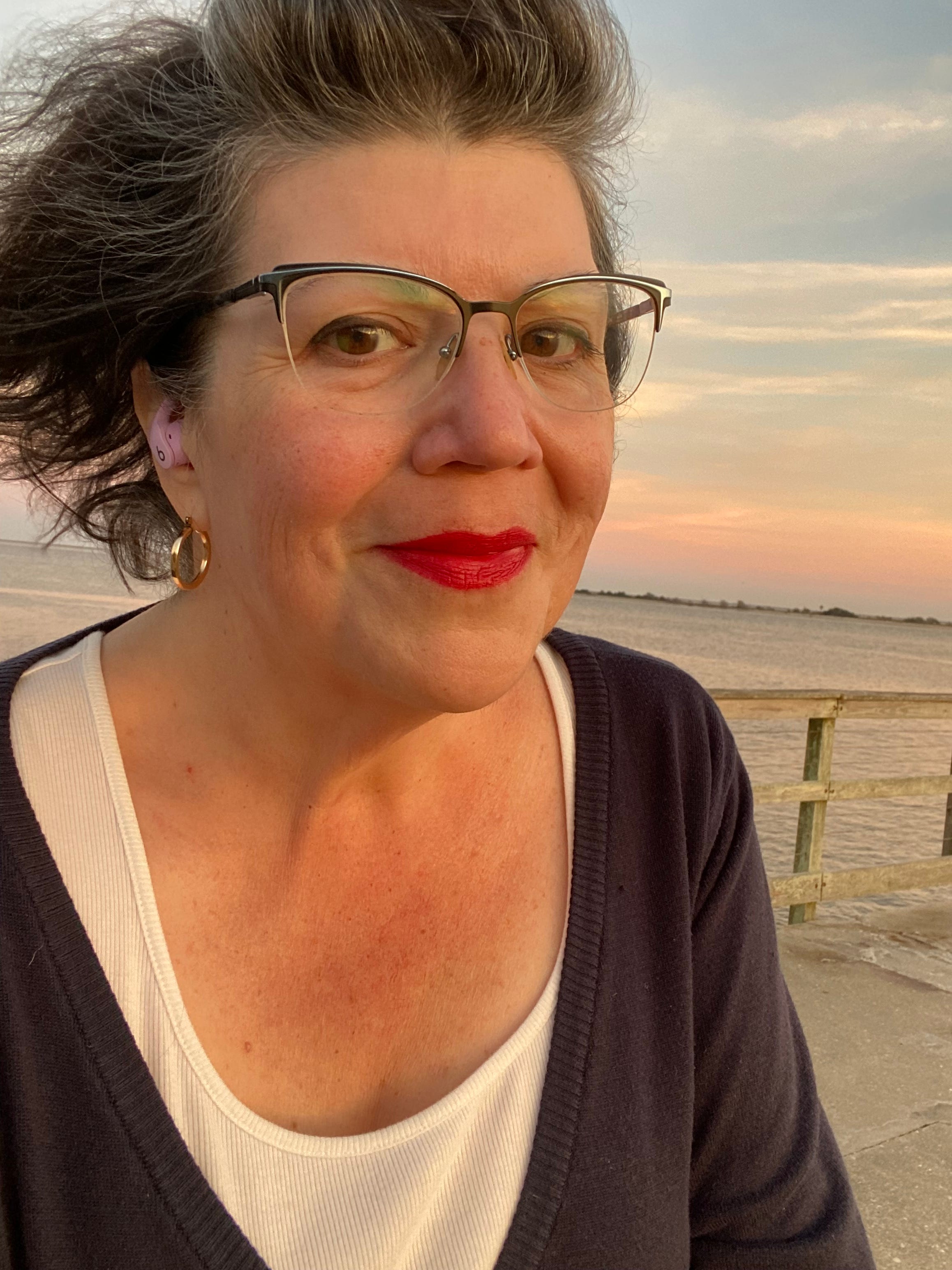
Dr. Hanne Blank Boyd is the author of a number of books including Fat (2020, Bloomsbury), Straight: The Surprisingly Short History of Heterosexuality (2014, Beacon Press), Virgin: The Untouched History (2007, Bloomsbury), It Ain’t Gonna Lick Itself: Housekeeping In Spite of It All (2024, serialized on Substack), and numerous others. Her books have been translated into several languages, including Japanese and Turkish.
She is a writer and editor providing a suite of literary services including book coaching, writing mentorship, developmental editing, and ghostwriting.
On Substack, Hanne writes Reasons Not to Quit, a newsletter for writers, creators, and everyone trying to think smarter, write better, and find ways to cope with life's arrrgh. Reasons Not to Quit began on Twitter in November 2016 as a daily dose of motivation and audacity, and ran for 5 years before taking a hiatus. It relaunched into a new incarnation on Substack in May 2024.
Hanne Blank Boyd lives with her family in a small town tucked into the salt marshes and historical pirate coves of the Cape Fear river delta, a few miles from a barrier island where she can regularly be found walking the dogs on the beach.

❓ Want to Support GuestStack?
If you’d like to support your fellow writers and their work, I recommend sharing these GuestStack posts, subscribing to our featured writers’ Substacks or other newsletters, and buying their books if you feel so inclined.
Want to do more to support GuestStack? You can also upgrade to a paid membership on From the Desk of Amy Suto: Make Writing Your Job for $8/month or a discounted $80/annually, which comes out to $1.53/week, or even less if you use the link below:
Don’t want to become a paid subscriber? All good! I’m just happy you’re here, regardless of your subscription status. I hope you enjoy all of the free content I share with you weekly, from the free Sunday posts to GuestStack essays, poetry, interviews, and more.
Wishing you warm writing vibes,
-Amy
Thank you for your wisdom, Hanne! I particularly loved the note about editors. I've grown so much as a copywriter since I started partnering with agencies, and working with editors. At first, I definitely had to put my ego aside, and the "I know best," mentality. The more rigorous the feedback, the better — I know it's an opportunity for improving my craft!