


📚 Editor’s Note: Sarah Copeland on Sacred Spaces and Standing Up for Your Worth
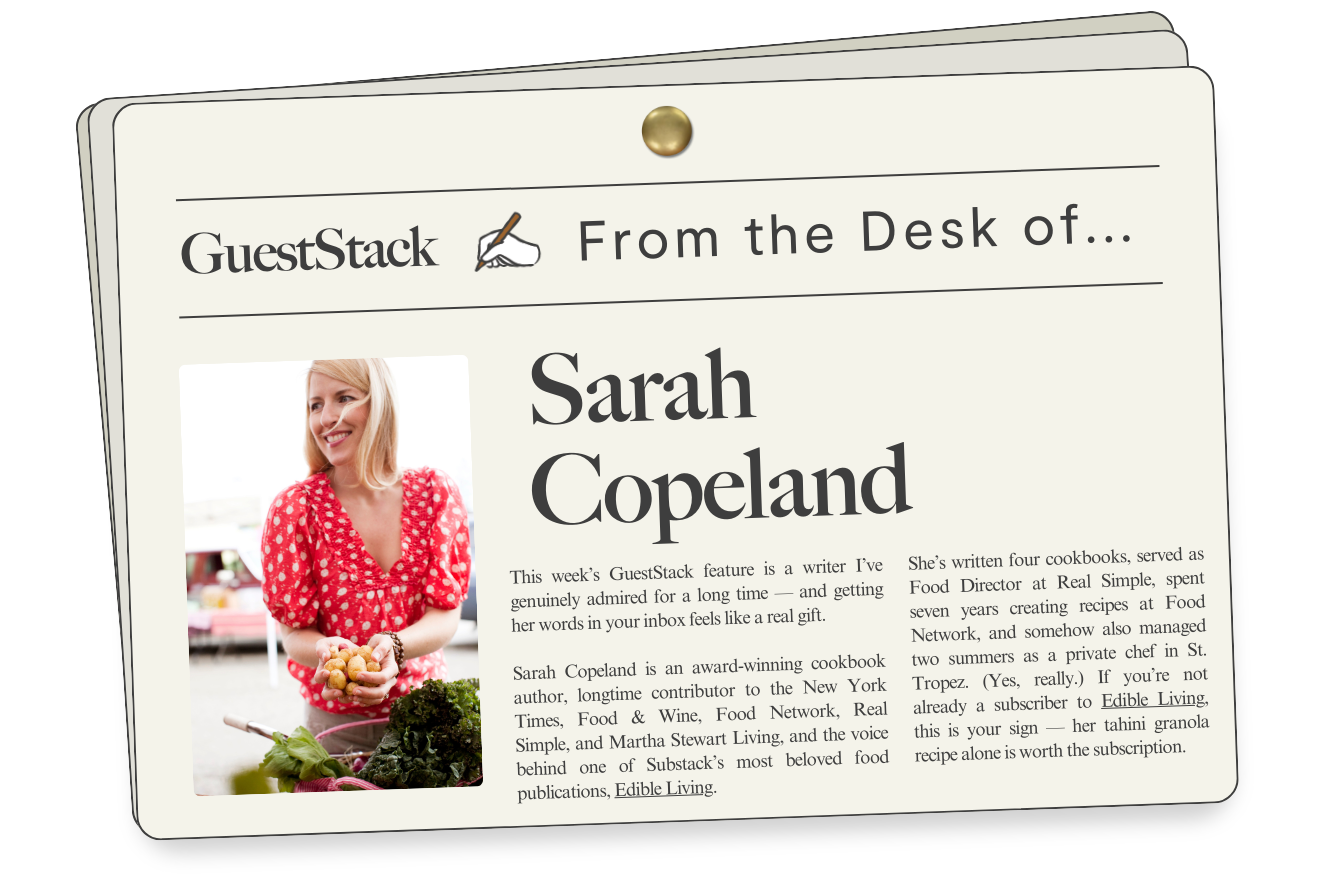
This week’s GuestStack feature is a writer I’ve genuinely admired for a long time — and getting her words in your inbox feels like a real gift.
Sarah Copeland is an award-winning cookbook author, longtime contributor to the New York Times, Food & Wine, Food Network, Real Simple, and Martha Stewart Living, and the voice behind one of Substack’s most beloved food publications, Edible Living. She’s written four cookbooks, served as Food Director at Real Simple, spent seven years creating recipes at Food Network, and somehow also managed two summers as a private chef in St. Tropez. (Yes, really.) If you’re not already a subscriber to Edible Living, this is your sign — her tahini granola recipe alone is worth the subscription.
But what I love most about Sarah isn’t the résumé — it’s the way she writes about the whole life of a working creative. From her 250-year-old blacksmith’s barn studio in the Hudson Valley to her travels across Hungary, Sarah is radically honest about what it actually takes to build a writing career with longevity, intention, and joy. She writes about food the way the best writers write about anything: as a way of understanding how we live, and how we might live better.
In this interview, she gets into charging your worth without apology, carving out sacred space for your work, and why she believes the readers who need your voice will always find you. For those of you building writing careers of your own, her perspective is the kind of reminder that sticks.
– Amy Suto
Editor & Curator of GuestStack
✍️ From the Desk of Sarah Copeland
Where’s your desk these days — and what does it look like?
I’m writing from my second-floor studio of our 250-year-old Blacksmith’s barn, 50 yards behind our house in the Hudson Valley. My actual desk is a 7-foot black walnut table my husband built me for our tenth wedding anniversary, with an arched frame and joined together with antique brass pins; it was originally intended to be our dining room table, but I’ve since adopted it as my desk. It’s beautiful and impractical (no drawers, etc). From my desk, I can see my house, my garden, our bunny’s little house, and the stop where my children get on and off the school bus; it’s my favorite place to be.
As an award-winning cookbook author and longtime contributor to top publications, you’ve got a lot on your plate — what inspired you to start your Substack Edible Living? And have you always taken such gorgeous food photography?
Because I had written almost exclusively for big brands like Real Simple, Food & Wine, and Food Network for the first decade plus of my career–either as a staff editor or on contract–it was hard to wrap my mind around writing a blog or a newsletter. A fellow food writer (Jenny Rosenstrach, a Substack OG) nudged me to get started on a low-stakes, low-lift effort about 4 years ago. But once I got started, I never wanted to stop. Working on my Substack quickly became where I spend 80% of my work week.
As for the photographs, thank you for the kind words! I was a dual major in magazine and photojournalism in college. Writing has always been my first love, and photography was my longtime side hustle, dating back to at least my mid-teens. But the two have become so intertwined in my work, art directing all my own cookbooks and often my work for brands, that I can no longer imagine one without the other.
What does “making writing your job” look like in your world right now?
I’m sorry to report that I used to make a lot more money as a writer than I do now. But that’s mostly because I stepped forward as the prominent/lead parent in my household (meaning full-time parenting without any paid or outside help), since COVID times, when my then-young kids were at home. In those days, I was writing or working as a writer 5 or more days a week, with overlap into nights and weekends. I had the best in-home childcare (full and later part-time babysitters) who helped me “do it all.”
These days, I write strictly while my kids are in school, and on the occasional late-night burst of energy. It means I make less (since it’s hard to scale your writing without actually writing more), but I’m grateful to have a really nice balance between my two worlds. I’m a better writer thanks to the complexities of my private life, and I’m certainly a better parent/partners/friend on days I’ve spent at least a few hours writing at my desk.
What’s one lesson you wish someone had told you earlier about the business of writing and creating recipes and food content?
To be absolutely shameless about charging for your worth. No one would dream of walking out of a salon without paying for their haircut, or walking out of a boutique with a new sweater without laying down their credit card or cash. And yet we continue, as writers, and as a culture, to undervalue the work, effort, and expertise of professional writers just because the market is saturated and the world is used to getting content (words, recipes, stories, listicles) for free.
Putting the writing aside, recipe creation and writing–and in particular the photography– is an expensive endeavor. High-quality work must be paid for, or we can’t expect quality at all.
What’s your writing routine like — or do you even have one?
I LOVED morning pages in my single days. That’s how I wrote my first book. Later, I did my best writing in cafes or on the subway, traveling to and from my desk jobs (usually as an editor).
Today, walking through my studio door is like jumping through a portal–I can leave family life behind and inhabit my writing brain fully. I sit and type at my desk for hours, skipping meals and bathroom breaks until I hear the brakes screech on the yellow bus, dropping my kids off from school. But then, as now, my absolute favorite time to write is on a weekend, when I notice that everyone is happily occupied and quietly tending to their own tasks/work/play. I grab my laptop and slip into the cozy chair in the corner of my bedroom–right by the window, in the late afternoon when the sun is streaming in, like a cat soaking in the sun. I love the feeling of my fingers racing across the keyboard–time slips away. It is then that I fully exhale, praying no one finds me until every thought is on the page, and yet accepting that it could be over at a moment’s notice. It’s like stolen time, one of life’s little gifts.
Was there a moment you realized, “Wait… I can actually do this” when it comes to being a food writer and author?
I have always believed in my writing–that writing, mine or anyone’s, is important. That words and stories are the great human connector. Since I studied Journalism, I was taught by multiple men/women who had ”made it,” who were actively working writers and (also, now, professors). One guest professor was a Pulitzer Prize winner, another wrote fabulous feminist pieces for Ms. magazine in the 70s and 80s, and had written several books about her own life. When I moved to New York City directly after these people were the biggest influence on my life, I had zero doubts about making a living as a writer. But I still thought I needed the big brands–the magazines and the editors and the big money men–to support me, to send me that paycheck, no matter how small.
The first time I realized I could really do it on my own terms happened much later. As I was turning the corner into my thirties, my oldest sister, a deft SVP, always said “the best investments you ever make are in yourself.” She encouraged me to attend the Greenbrier Food Writers’ Symposium, with an entry fee that was a massive splurge for me at the time. Once I got there, I had dinner every night with the top working writers and editors of the era: Russ Parsons (LA Times), Andrea Nguyen (a widely published food writer), Margo True (writer for Saveur and Sunset mags), Ann Taylor Pittman (then of Cooking Light), Bill LeBlonde (from Chronicle Books), Antonia Allegra (oft called the fairy Godmother of food writing), Don Fry (reveared writing coach and scholar). Sitting among people whose daily rhythm was writing (for money!!) renewed my confidence that I could do it too.
Don Fry made us read our writing aloud back to a room full of greats and never let us back down. He said I had a real “voice” and made me promise to stop apologizing for my opinions. He put us on the spot; he taught us to get out of our own way, and that we could survive saying what we were put on this earth to say, no matter who was in the room.
Not long after, Bill LeBlonde signed me as one of his authors; I wrote my first book the next year.
What’s something you tried that didn’t work — and what did you learn from it?
I recently went out to market with a Hungarian Cookbook proposal that I have spent well over a decade researching and writing. The investment has been massive: dozens of trips back and forth to Hungary, years of reading and researching, and tons of writing and rewriting. I have never worked harder on anything in my life. The book didn’t sell–even after publishing four books, with accolades like James Beard-nominated, and “Best of” lists from the New York Times, Bon Appétit next to my name.
This might have felt like a giant blow. Not only did my first four books sell quickly and easily, making this a harsh contrast, but this book felt deeply important to me–something I am uniquely qualified to write, something I feel needs to be written, and full of recipes and stories I have passionately wanted to tell for many, many years. But the timing wasn’t right for the marketplace. And if I were honest with myself, the timing wasn’t right for me either.
I thought it would crush me to have to put that to the side after so much love and work went into it. But I learned that I can handle rejection. And that not all rejection is personal. I know my work is respected, and that editors trust the integrity of my work, but no one wants to go to the market right now with a book that may not sell widely. There’s too much at stake for publishing houses right now. And I know there will be a right time for that book–somewhere in the future. If it’s meant to be, I will be the one to write it. And if not, I will do other great, valued work that the world needs from me even more.
How do you find or create opportunities for yourself as a writer and creator?
Much of my career has been based on word of mouth, recommendations, and serendipity. I keep good and strong ties with editors and peers in our industry. I am blessed to have been recruited into some of my most foundational roles, and two of my four books were commissioned from editors I love and trust.
That said, the market is more saturated than ever, and having to pitch (or deciding to pitch) does help you get very clear on what you most want to write and go after. I’ve done several projects in the last three to four years that, in retrospect, were a detour from the work that matters most to me. I’m grateful for those projects (and paychecks), and I always learn from new assignments and new editor relationships that help me stretch and grow, but I plan for this year to be a return to my core mission–what and who I hope to impact through my work.
What’s the best investment you’ve made in your writing life (time, money, or energy)?
As a parent, I have to say carving out a private place to write has been my best investment. Many years ago, when my kids were very young, a dear friend, a visual artist (her medium is mostly painting), came for a visit and saw my desk crammed against the wall in our then shared den/family room/toy room. Yes, I’d put up beautiful wallpaper and a pinboard with all my favorite tokens and talismans. The desk was roomy and well organized, and I had a nice big iMac computer to write on–but why wasn’t my desk facing out the window? she asked. And why didn’t I position the couch to partition off at least ⅓ if not more of that deep room just for myself? I had never considered it (after all, I did some of my best work on the subway, and on the kitchen counter in our tiny studio apartment in the years I’d lived in NYC. I was used to working in cramped spaces).
Naturally, I moved my desk shortly after that, and that change was good for me–and for my family, defining my work and my space as much as much of focus of our family life as anything else–not an afterthought. Not something to squeeze into the margins.
Soon after, I started dreaming of my own studio and began writing down specifically how I wanted it to look and feel, in great detail (colors, light, windows, and how I would feel in that space). That same year, I took on a commissioned book project with a strong advance that paid for us to fully renovate our barn into my studio (with enormous credit to my husband, who did the whole thing himself during COVID times). Now, it is my sacred space. No one enters without permission.
I think my sister and my friend were both saying the same thing: invest in yourself. People will only treat writing like it’s your hobby or your side hustle if you treat it that way. If you want this to be your career, treat it like your career. Honor the space, the time, and the tools you need to thrive as a writer.
Edible Living is a bestselling publication here on Substack — what were the ways you grew it? Anything out of the ordinary, or surprising to you?
I was not an OG blogger, and never really mastered the time to learn or understand SEO, so outside of Instagram, I had never grown any kind of a following or amassed a list on my own. Most of my work from the first decade and a half of my career is owned by a big brand, which made me feel limited, at best. So coming to Substack felt like I might just be whispering into a void. At first, I think I grew, because my readers could tell that I loved it. I was consistent, came to them enthusiastically with something new every week for four solid years. I was excited every time I sat down to write, whether it got one comment or twelve or none! I think my readers could feel that genuine joy. I believed in our connection, however small, it mattered to them and to me.
My growth has always been steady and slow. But there were definitely moments each year where bigger growth happened. In 2022, we moved to Hungary for 5 months, and my writing suddenly attracted multitudes of people with either a connection to Hungary (via family, or some who had lived there or married a Hungarian) or women who dreamed of living abroad with their own families and wanted to know how we did it.
The next year, back in the US, I was missing Europe, so I did a guest post series around Christmas, sharing the lives and holiday traditions of 6 women living/working abroad. The following year, it was twelve days of Christmas cookies (also heavily European-focused) that brought new readers in. Right now, I’m doing a Repertoire series, which is a practical guide for the home and kitchen of busy families like mine.
Of course, some readers may fall away as you evolve and tweak your content, as you move through different stages of your own life, but I (and we all) have to trust that the readers who need my voice will find me.
What’s something you’re currently obsessed with — and how is it influencing your writing or creating?
Paris! It sounds cliché, but I lived in Paris and later in St. Tropez in my early twenties, for three consecutive springs/summers, and it’s one of the places I felt most alive and myself, and the most brave. I really let my passion for Hungary usurp what a major part of my life France, French culture, cuisine, and language was. Right now, it’s bubbling back up for me strongly–an urge to reclaim a part of myself that was lost in motherhood and family life.
Substack has also brought me to a new love of fashion–I worked in fashion/women’s magazines earlier in my career before my food deep dive, but then I have never really followed fashion writers/or influencers for many, many years. I really love the way the writers on Substack approach fashion in a fresh, non-consumerist way. It’s so refreshing. I dream of being one of those completely chic older women who wear their clothes in an unapologetically confident way.

👋 About Sarah Copeland, This Week’s Featured GuestStack Writer
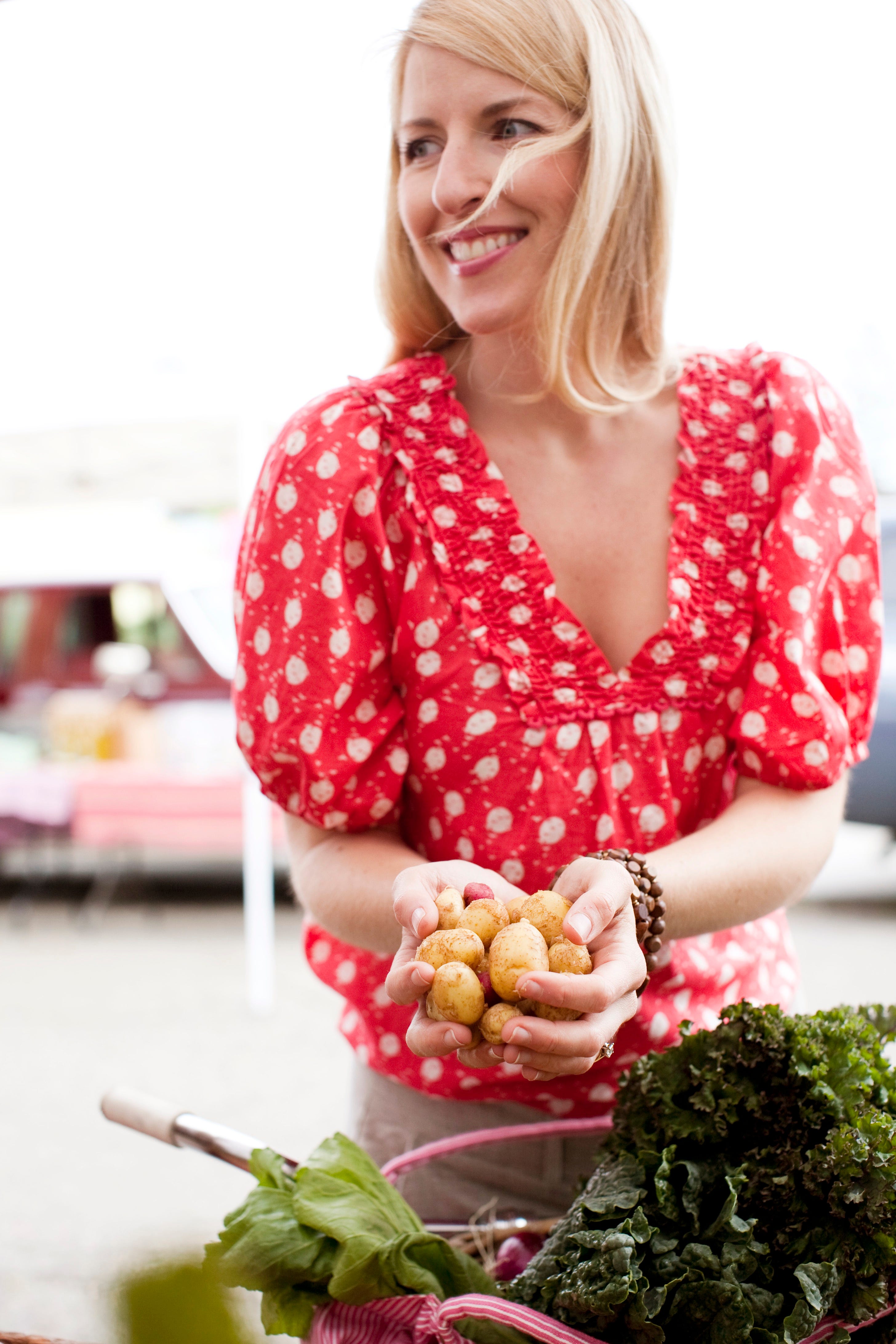
Sarah Copeland is a writer, cook, and author of four beloved cookbooks—Every Day Is Saturday, Feast, Instant Family Meals, and The Newlywed Cookbook. She is the voice behind Edible Living on Substack, where she writes about building a repertoire for real life. Her recipes and essays have appeared in outlets including NYT Cooking, Food & Wine, Food Network, and Martha Stewart. Her work lives at the intersection of food, family, and intentional living.
From her home in the Hudson Valley, Sarah writes about the structure and meaning of daily life—marriage, motherhood, work, travel, and the practice of gathering. Her work examines how we live, and how we might live better.
Find Sarah on…
INTRO (where readers can hire Sarah for specific career coaching on food writing or writing a cookbook proposal)

I really enjoyed this interview! Her barn studio reminded me of Olivia Muenter's writing cottage...both are now on my vision board :)